Gone are the days of singular AI tools. With all the latest advancements in the field of AI and machine learning, we are now in the age of multi-agent systems. In this article, we will explore what these are. In our quest to understand multi-agent systems, we will go beyond simple definitions to see how these networks of AI agents actually operate. From their unique advantages in flexibility and scalability to real-world applications in healthcare, logistics, and defense, multi-agent systems open new ways of solving problems that single AIs can’t. This article also explores their architectures, coordination strategies, and the challenges of building them responsibly in the real world.
So without any further ado, let’s dive right in.
What is a Multi-Agent System?
A multi-agent system (MAS) is a group of AI agents that work together to complete tasks for a user or another system. It’s not just about having many Artificial intelligences in one place. It’s about building a team that works collaboratively. Each agent has its own skills or knowledge, but the real power comes when they coordinate to reach shared goals.
This approach creates specialized, flexible teams where each agent’s strengths are improved through teamwork. These systems can grow to include hundreds or even thousands of agents. That makes them essential for handling large, complex tasks that one AI alone couldn’t manage.
Advantages of Multi-Agent Systems
Multi-agent systems have many advantages that help solve complex problems.
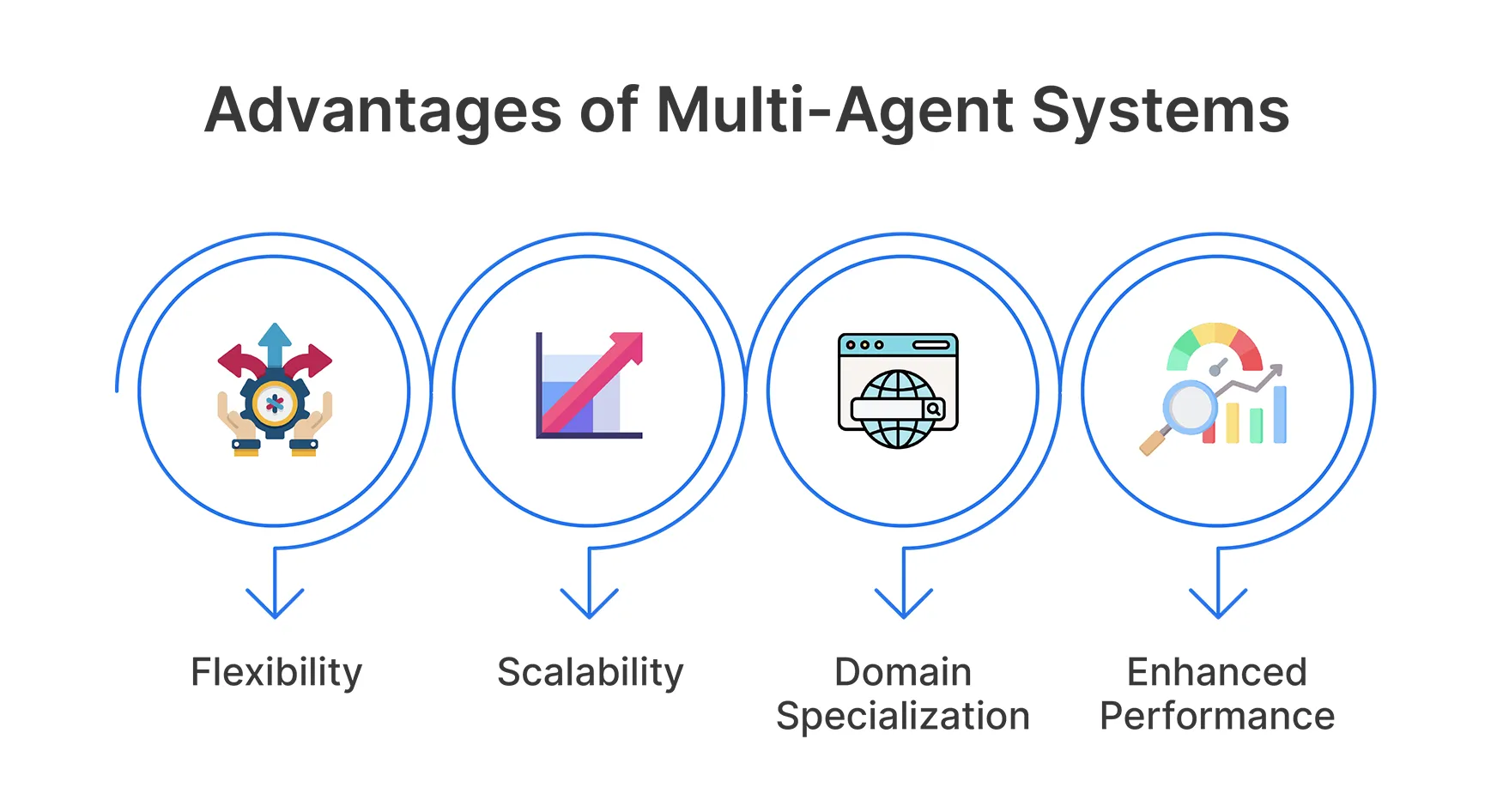
Flexibility
One big benefit of a multi-agent system is that MAS can quickly adapt to changes by adding, removing, or adjusting agents. For example, in logistics, if a truck breaks down, other agents can reroute deliveries and change schedules to keep things running smoothly.
Scalability
Yet another strength of a multi-agent system. When many agents share information, they can solve much harder problems together. Let’s consider the thousands of agents mapping the human genome at the same time, sharing results, and improving their knowledge as a team.
Domain specialization
Each agent in a multi-agent system can focus on what it does best. Instead of one Artificial Intelligence trying to do everything, you have special agents for things like sensor data, schedule planning, or managing resources. This division of work makes the whole system simpler and more effective – an AI solution designed for modular efficiency and task-specific precision.
Enhanced Performance
Better performance comes from working and learning together. MAS can come up with more ideas, test different solutions, and learn faster by sharing what they know. This leads to stronger and more flexible solutions that can handle real-world challenges.
Single-Agent vs Multi-Agent Approaches
There is an important difference between single-agent systems and multi-agent systems.
Single-agent systems: They plan, use tools, and finish tasks on their own. They may use other agents, but only as simple tools. For example, they might look up data in a database or use a calculator without any real teamwork.
Multi-agent systems work differently. Agents in these systems understand each other’s goals, memory, and plans. Instead of one-time question-and-answer interactions, they have ongoing teamwork.
Agents build mental models of their partners. They anticipate what others need, coordinate their actions, and adjust based on shared goals.
Communication can be direct, like sending messages to other agents. It can also be indirect, such as leaving updates in a shared space. This is like leaving notes on a shared project plan. It turns a one-time exchange into an evolving, team-based process.
Architectures of Multi-Agent Systems
There are two basic types of architectures of multi-agent systems:
Centralized Networks
Centralized networks have one main unit that holds the global knowledge base. This central unit connects all agents and coordinates their work. Such a design makes communication easy and keeps information consistent across agents. It works like a conductor leading an orchestra.
But there is a problem. Centralized networks create a single point of failure. If the central unit stops working, the entire system can fail.
Decentralized Networks
Decentralized networks, on the other hand, remove that central control. Agents share information directly with their neighbors. They communicate peer-to-peer or use shared signals in the environment.
This setup is more robust and modular. When one agent fails, the others can still do their jobs.
However, coordinating goals is harder. Agents need advanced negotiation rules, consensus methods, and dynamic task sharing to stay aligned and work well together.
Organizational Structures in MAS
Multi-agent systems (MAS) can use different internal structures to organize how agents work together.
Hierarchical Structures
Hierarchical structures are like company org charts. Agents are placed in levels or tiers. Higher-level agents have bigger responsibilities, while lower-level agents do specialized tasks.
This setup gives clear control and efficient work. But it can be rigid and has a single point of failure if the top level breaks down.
Holonic structures
Then there are Holonic structures, inspired by nature. A holon is both a whole and a part.
For example, a factory machine might look like one unit but contains many sub-agents. These sub-agents can also work in other holons. This creates modular, reusable, and self-organizing systems that copy the complexity of living things.
Coalition Structures
Coalition structures are temporary groups. Agents team up to handle specific challenges. Once the task is done, they split up. This setup is flexible and good for sudden workloads. But it can become complicated in fast-changing situations.
Teams
Teams are different because they are permanent and interconnected. Agents in a team work closely and all the time toward shared goals. They have clear roles and responsibilities. This makes them ideal for long-term, complex problem-solving.
Flocking and Swarming
Multi-agent systems often use coordination strategies from nature. These strategies help many agents work together without a central controller.
Flocking
Flocking copies how birds or fish move in groups. Each agent follows three simple rules:
- Separation: Stay far enough apart to avoid hitting others. For example, trains keep a safe distance on the same track.
- Alignment: Match the direction and speed of nearby agents. This is like trains syncing their speeds to move smoothly together.
- Cohesion: Stay close enough to keep the group together. In transport networks, trains plan routes so they remain connected as part of a reliable schedule.
These rules create smooth, coordinated movement even without a central command. That’s why flocking works well for managing transportation systems. Trains as agents can automatically keep safe gaps, adjust speeds, and change routes to handle traffic in real time.
Swarming
Swarming is another nature-inspired strategy. It focuses on organizing space and exploring areas as a group. Bees and ants are classic examples. Agents in a swarm use local interactions to gather and self-organize.
One big benefit of swarming is control efficiency. A single human operator can set high-level goals while the swarm handles the details. This makes it much easier to manage large-scale operations. It’s perfect for things like drone fleets or warehouse robots that need to work together at scale.
In short, flocking is best for keeping groups moving in sync, while swarming is ideal for spreading out to cover and explore space. Both rely on simple local rules to create smart, adaptive group behavior without central control.
Real-World Applications of Multi-Agent Systems
Multi-agent systems (MAS) have many real-world uses. They help many industries work smarter and more efficiently.
Transportation
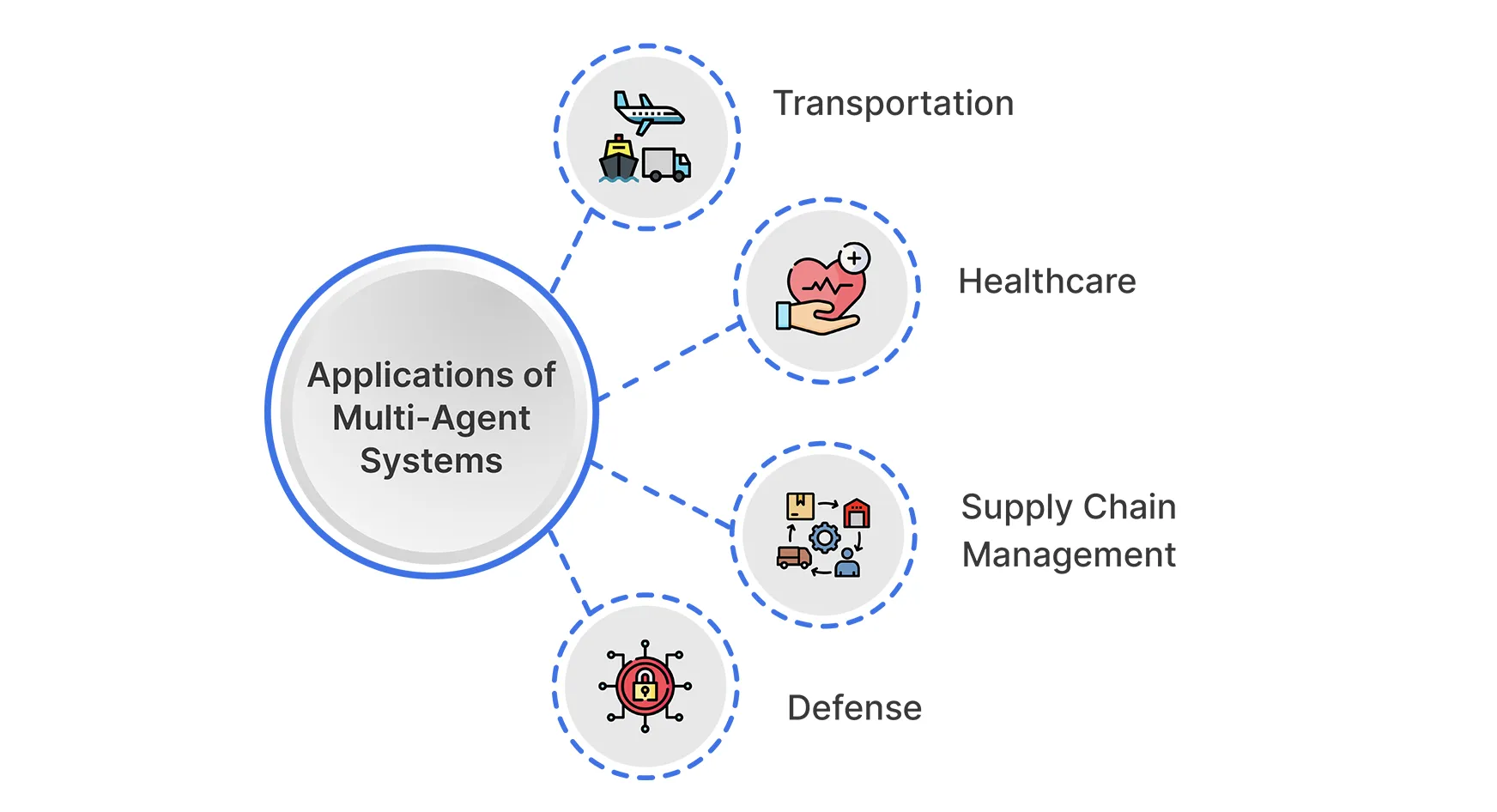
MAS helps manage smart city traffic. They can coordinate self-driving taxis and improve rail and air networks. Agents share real-time data to choose better routes, let emergency vehicles pass first, and keep traffic flowing smoothly.
Healthcare
MAS help predict diseases by analyzing genetic data. They can also simulate how diseases spread in a community. Agents can model people, hospitals, and entire cities. This helps plan better responses and improve public health.
Supply Chain Management
MAS connect suppliers, manufacturers, shippers, and retailers. Agents can negotiate routes and update schedules when problems happen, like delays or shortages. This keeps goods moving smoothly across the world.
Defense
MAS are used in military and security applications. They can simulate battle scenarios and plan responses. Agents help defend against cyberattacks and manage autonomous drones for surveillance or delivering supplies. This improves both physical security and cybersecurity.
Agentic Retrieval-Augmented Generation (RAG) in Enterprises
Agentic RAG is changing how companies use AI to manage information.
Old search tools and simple AI struggle with the huge amount of data businesses have. Agentic RAG fixes this problem. It uses teams of special agents that connect to all the company’s knowledge.
Instead of one AI doing everything alone, each agent focuses on one type of data. For example:
- One agent handles sales systems.
- Another manages technical documents.
- A third works with financial reports.
These agents work together to find, combine, and use information better. This team approach turns data into action. Agents can:
- Write responses.
- Update records.
- Make reports.
- Start workflows automatically.
With Agentic RAG, AI becomes an active helper. It supports businesses by solving problems and making work easier.
Orchestration: Working Together
Even smart, independent agents need orchestration to work well. Orchestration is a plan that helps agents reach the same goal. It sets clear roles, defines how they talk, and helps fix conflicts.
Without orchestration, agents might get in each other’s way or do the same task twice. That wastes time and causes confusion.
Good orchestration keeps things running smoothly. It turns many agents into one strong, organized team that can solve hard problems together.
Challenges in Building Multi-Agent Systems
Multi-agent systems have huge potential, but they also face big challenges.
Agent malfunctions, for instance, can affect the entire system. When many agents share the same base model, one flaw can spread to all of them. This risk means teams need strong testing and different designs to avoid single points of failure.
Coordination complexity is another major issue. Agents need to negotiate, adapt, and work together in changing environments. This requires advanced rules and sometimes even game theory to help them cooperate well.
Emergent behavior can also be hard to predict. Simple local rules can lead to good global results. But they can also create unexpected or even chaotic outcomes that are tough to spot and fix.
Human Oversight and Governance
Good governance is essential for multi-agent systems. They must work ethically, transparently, and follow all rules. Organizations need to set clear ethical guidelines and define what agent behaviors are acceptable. They must ensure fairness and accountability at all times.
Performance metrics should be set and watched closely. This helps teams find and fix problems early. Systems also need strong testing as they take on new tasks or add more agents. This testing helps keep them reliable. Finally, continuous monitoring and regular checks are needed to maintain trust and handle new challenges as they come up.
Conclusion
It’s time to move from simple AI tools to smart, connected systems. Multi-Agent AI helps you solve tough problems, improve teamwork, and grow your systems easily. So make sure that you start planning today, and build flexible, future-ready solutions that make your organization stronger.
Login to continue reading and enjoy expert-curated content.