The European Union has invited comments on how effective its Digital Markets Act is, so Apple has taken the opportunity to file objections that are unusually strong, unusually vehement — and also absolutely right.
The Digital Markets Act (DMA) is how the European Union (EU) and its European Commission (EC) were able to fine Apple $570 million over allegedly treating consumers unfairly. It’s how the EU could fine the company $2 billion for purportedly abusing its monopoly position and again doing so to the detriment of European users.
Now the EU has begun a review of the DMA and entered a consultation period in which firms affected by it can make their case for any changes they want. Apple doesn’t just want changes, though, it was the law repealed and replaced — and it’s saying that publicly as well as directly to the EU.
“Regulators claimed the DMA would promote competition and give European consumers more choices,” says Apple in a statement. “The law is not living up to those promises. In fact, it’s having some of the opposite effects.”
Specifically, Apple contends that the DMA is why it has not released iPhone Mirroring in the EU, and the new AirPods Pro Live Translation feature will not work in the region. “[According] to the European Commission, under the DMA it’s illegal for us to share these features with Apple users until we bring them to other companies’ products,” says Apple. “If we shared them any sooner, we’d be fined and potentially forced to stop shipping our products in the EU.”

Live Activities on the Mac is another feature that won’t be released in the EU
Apple argues that it always launches features and then over time makes them available to other developers via APIs. It says that the EU demands that every feature be immediately available to competitors, day and date with their implementation on Apple hardware.
According to Apple, that’s at least an unreasonable and potentially an impossible burden on its engineering teams. It’s also, though, something that Apple claims no other company is required to do.
That claim is 100% accurate.
The DMA applies to what are called Gatekeeper companies. Every gatekeeper firm is a Big Tech company that has over a certain number of users within the EU. There are six, and five of them are US Big Tech.
- Alphabet
- Amazon
- Apple
- ByteDance
- Meta
- Microsoft
ByteDance is best known for owning TikTok globally — at least for now — and Meta is the parent company of Facebook. As such, Meta has also been fined under the DMA, although the sums are a fraction of those imposed on Apple.
Apple argues that it is the sole company from this list that is being required to give away its intellectual property for free. The company says that it has directly asked the EU why this is the case, but has not been answered.
Frankly, we’re not expecting transparency from the EU on that. Apple isn’t either.
It also says that it has made unspecified proposals that, in Apple’s opinion, would allow it to comply with the DMA without unreasonable costs. But again, the EU has allegedly ignored those proposals and prefers home-grown ones suggested by the overwhelmingly dominant music streaming firm in the EU, Spotify, for example.
In May 2025, Apple claimed that the EU had explicitly told it not to implement a compliance suggestion — and then fined it for not doing so. At the time, the EU said that its fine “only addresses the solution that Apple decided to roll out, not any other hypothetical approach that the company might have been considering.”
EU and Apple both say consumers are key
At the heart of both the EU’s DMA demands and Apple’s rebuttal of them is the claim that they are all working in the interests of the consumer. Apple is hardly altruistic, and like any large corporation it is surely focused on making more money.
But central to Apple’s moneymaking is privacy and security, which Apple consistently champions as its main differentiator from its rivals. Those do benefit the consumers who buy its products — and Apple says that the EU’s DMA is actively making consumer choice worse.
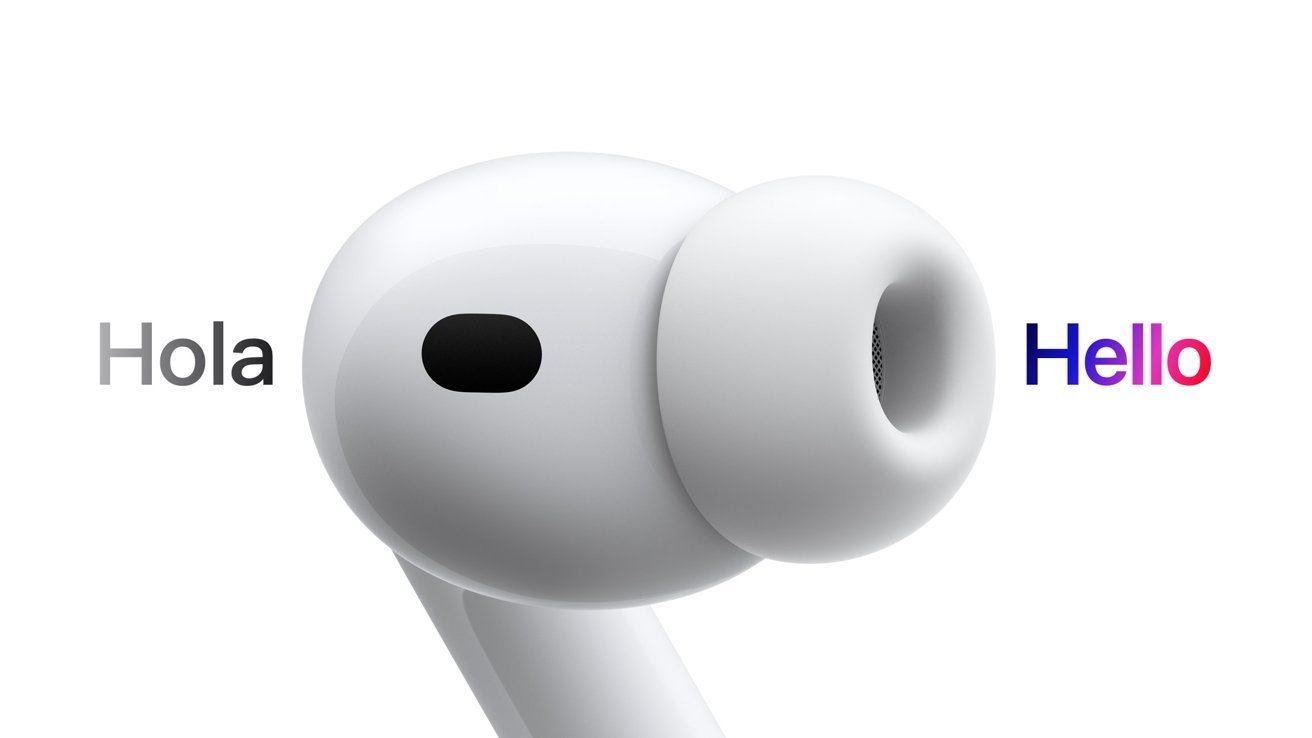
Live Translation can translate many European languages — but not for European users — image credit: Apple
Specifically, Apple says that the DMA does not help consumers at all. It says that instead the law has proven to be advantageous solely to other large companies.
For instance, fining Apple Music for allegedly abusing its monopoly position was predicated on how that is harming consumers. However, Apple Music does not have close to a monopoly position.
It lags dramatically far behind the real market leader, Spotify — which happens to be a European company. According to Apple, fining Apple Music helps firms like Spotify and does not in any way help the consumers the law is supposed to protect.
Apple says that the conditions being imposed on it, and solely it, are doing the opposite of giving Europeans better options.
“By forcing Apple to build features and technologies for non-Apple products, the DMA is making the options available to European consumers more similar,” says the company. “For instance, the changes to app marketplaces are making iOS look more like Android — and that reduces choice.”
Security issues
Apple says that no other firm is being required to build features for its rivals. It says that instead, under the terms of the DMA, those rivals are enabled to demand access to Apple technology — and user data.
Specifically, its new statement repeats earlier Apple reports of the type of information being sought by rivals such as Facebook. In the new statement, Apple says that the DMA demands that it allows companies access to “the complete content of a user’s notifications,” and “the full history of Wi-Fi networks a user has joined.”
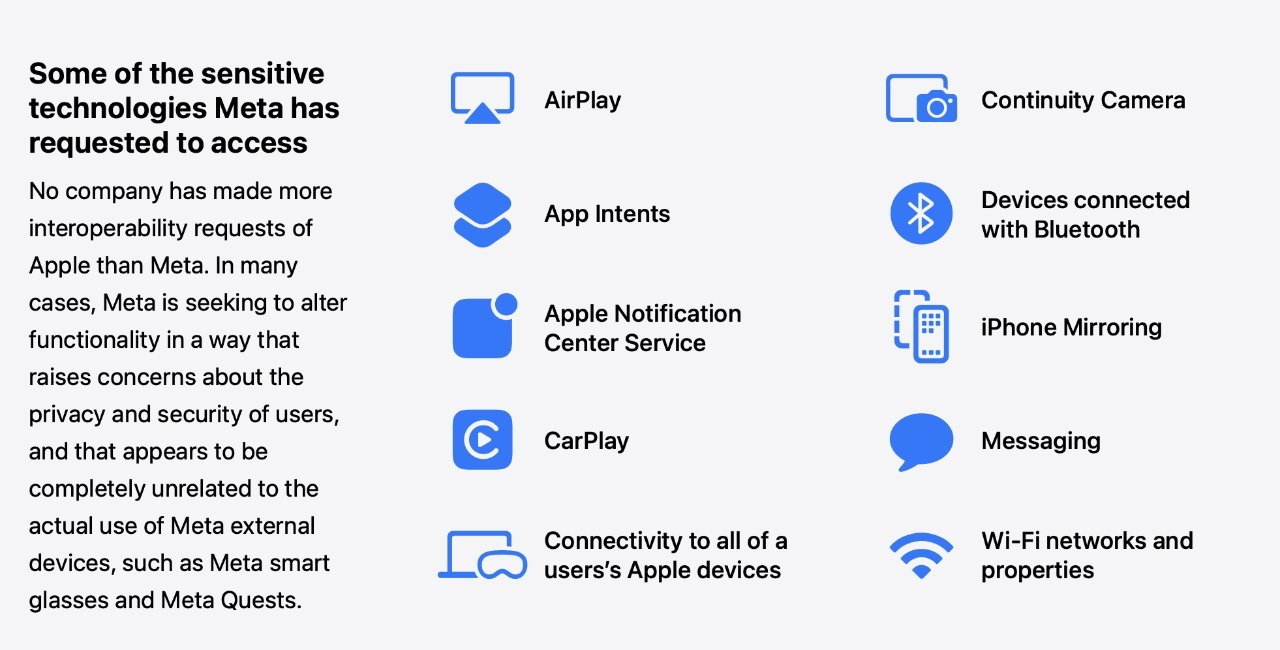
From a previous Apple White paper: examples of what the DMA allows Facebook to ask for
Facebook wants those to work around Apple’s privacy protections, circumvent App Tracking Transparency, and serve targeted ads to users to make more money, despite being one of those gatekeeper companies. Despite Facebook’s shrugs and protestations, it is apparent that them having such private data would be profitable for Facebook. And Google. And Spotify.
“Large companies continue to submit new requests to collect even more data — putting our EU users at much higher risk of surveillance and tracking,” says Apple. “Our teams have explained these risks to the European Commission, but so far, they haven’t accepted privacy and security concerns as valid reasons to turn a request down.”
Apple is right
The core idea that the DMA is there to protect consumers is laudable. And the EU should be applauded for implementing laws when most of the rest of the world is still only talking about it.
However, absolutely everything else about that implementation is flawed — and it’s also a target silently moving in the dark that Apple is expected to bullseye when they take a shot. Apple claims, and it’s been very clear, that the European Commission is constantly reinterpreting the law, and that makes it nearly impossible for companies to know how to comply.
There is an appeals process, but it takes “months or years.” In the meantime, Apple is required to abide by demands immediately “even if that does irreversible harm to users.”
And by users, we mean you, even if you live in the US.
“And the penalties for failing to comply are totally arbitrary,” says Apple. “They’re applied unevenly, and they’re designed to punish companies instead of promoting competition.”
This is a case of one behemoth of a company arguing against a European Union comprised of 27 member states. But it ultimately has to be about the consumers in the middle, and there is where the law is failing.
Maybe Apple is really concerned with its sales, but its points are valid. The DMA’s core principle of protecting users is right, but its implementation does mean that users are being badly affected.
What happens next
Apple filed its submission to the European Commission’s review of the DMA on the very last day that it was allowed to. The EC will now be studying all of the submissions, and preparing a review report.
European Parliament building in Strasbourg — image credit: EU
The Commission is required to present a final report to the European Parliament, the Council and the European Economic and Social Committee. The deadline for that filing is May 3, 2026.
There will then be another such review every three years thereafter.
Apple stands no chance at all of getting the DMA repealed — even though the EU regime that created the DMA and got it into law has now left.
What it might be able to do, though, is get the new EU regime to set clearer conditions than the murky ones that exist now. It might get the new regime to consider security more than it has — although it seemingly has not considered user security and privacy whatsoever.
Apple has told AppleInsider that it does have engineering teams working on bringing features like Live Translation to the EU. But reportedly the engineering challenge of doing it with AirPods Pro was hard enough, so trying to get it to work with countless rival products is at the very least difficult.
Then getting it to work with rival products and keeping the user’s data safe and secure is an order of magnitude harder.
Until the DMA drops its willful ignoring of user privacy, it’s never going to protect consumers. It will just move money from Apple to mostly European competitors. And it will force data and technology transfers to Meta, Google, and local favorite Spotify.
Apple hasn’t any hope of the DMA being repealed. It is actually right that — at least in its present form — it should be.