Overview:-
- Explore the essentials of SaaS product management, from its stages to its key objectives.
- Learn how AI, collaboration, and data-driven decisions drive success and retention.
- Discover the challenges and ways to overcome them, along with the metrics and skills that one needs to focus on.
Ever wondered what powers the services you use every single day? That’s the magic of SaaS product management.
Here, the challenge is real and the impact is one-of-a-kind. You’re at the command, steering cloud-based products through rapid deployments, subscription models, and surprisingly unpredictable user feedback.
Every move matters, from scaling with sharp precision to slashing churn like a pro. Forget the old software release cycles; this is a dynamic SaaS ecosystem that demands agility, innovation, and relentless customer focus.
So, if you crave business growth, data-driven results, and product features users actually want, you’re in the right place.
What Is SaaS Product Management?
You’re not just managing software, you’re leading a cloud-based product that evolves in real-time.
SaaS product management involves guiding products deployed over the internet, purchased as subscriptions, and continually updated. It’s your job to prioritize user needs, automate development, and drive retention.
In simpler terms, SaaS product management means overseeing scalable, cloud-based products delivered by subscription, focusing on user needs, agile delivery, and continuous innovation within the SaaS ecosystem.
- Unique SaaS Lifecycle: Products exist post-launch, always improving. You never ‘finish’ – you just iterate and grow. SaaS products require endless enhancements as competition and customer expectations shift.
- User-Centric Approach: Every feature, update, and fix should push your user engagement up. Listening to users keeps your SaaS product competitive and relevant.
- Continuous Delivery: Deploy, monitor, measure, improve – fast, so your competitors don’t overtake you. Continuous enhancements mean your SaaS product never goes out of date.
Hire skilled Soft Suave developers to streamline features and grow faster. Start optimizing your SaaS today!

SaaS Product Management vs Traditional Product Management
So, what’s the difference between SaaS product management vs traditional product management? Let’s compare.
| Feature | SaaS Product Management | Traditional Product Management |
| Deployment Model | Cloud-based, subscription | One-time delivery, licensing |
| Updates | Continuous, automated | Infrequent, manual |
| Customer Data | Real-time, extensive | Limited, historical |
| Feedback Loops | Built-in, fast | Slow, often disconnected |
| Retention Focus | High – Subscriptions drive everything | Lower – Buyers move on after purchase |
SaaS isn’t just building; it’s continuously growing. You plan, develop, launch, and then instantly begin iterating. Old-school models? You ship, then mostly rest. Here, deploy and repeat is life.
SaaS lets you impact thousands of users overnight, not just one big release every few years. Scalability through cloud deployment is a game-changer for product growth.
Key Objectives of SaaS Product Management
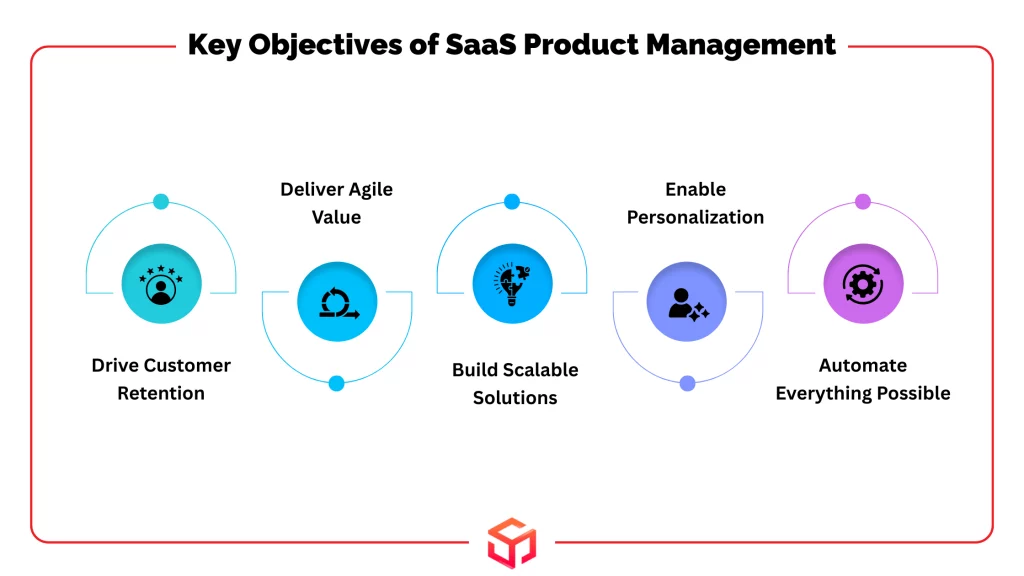
What are you actually trying to accomplish here?
- Drive Customer Retention: Subscription models mean you win by keeping users coming back. Recurring revenue is only possible if customers don’t churn.
- Deliver Agile Value: Fast response to user feedback, agile delivery is your secret weapon. Agile cycles adapt your SaaS to evolving user needs.
- Build Scalable Solutions: Architect products that can grow from 10 to 1,000,000 users painlessly. Scalability ensures that your technology won’t limit your business growth.
- Enable Personalization: Data-driven decisions let you tailor experiences, predict needs, and increase loyalty. Personalized SaaS products convert and retain better than generic ones.
- Automate Everything Possible: Save time, reduce errors, boost speed. AI-powered automation is the new standard. Automation frees you up to focus on strategy instead of manual tasks.
Are you laser-focused on these goals? That’s step one.
Stages of SaaS Product Management
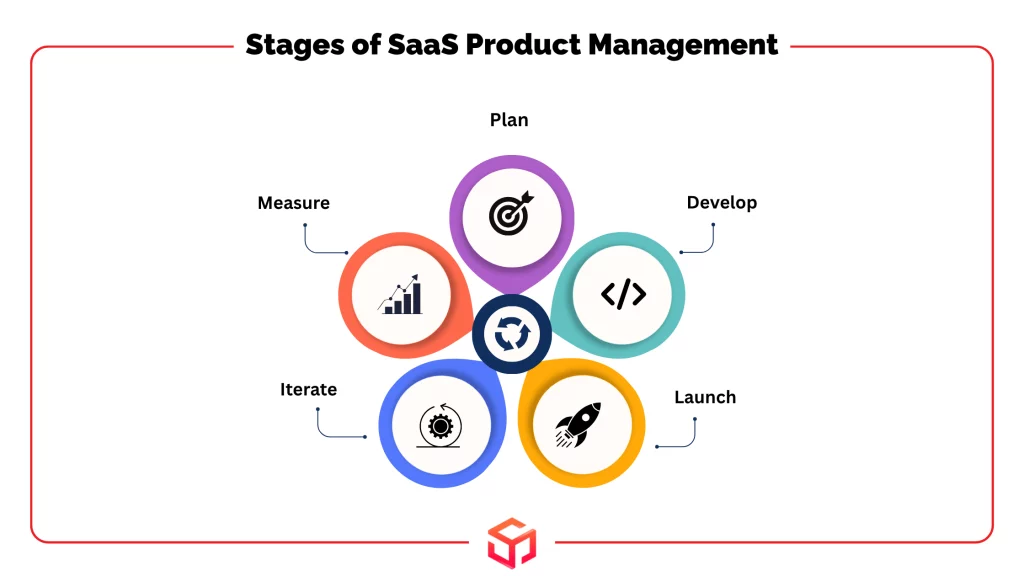
How do you actually move a SaaS product from zero to a finished product? Let’s break down the lifecycle.
- Plan: Sketch your vision, research your market, and core values. Proper planning avoids wasted development effort later.
- Develop: Build, test, and refine your cloud-based solution using feedback loops. Agile development gets you to MVP faster and smarter.
- Launch: Deploy your scalable product, engage early adopters, and start measuring results. A successful launch sets the pace for lifetime product success.
- Iterate: Roll out updates continually. Listen, learn, adapt, re-launch features. Feedback-driven iteration ensures your SaaS stays relevant.
- Measure: Track KPIs, identify churn risks, and focus efforts where data tells you. Measurement keeps your growth on track.
The best products never sit still; they sprint forward. Many companies accelerate timelines by outsourcing saas development, allowing them to leverage specialized expertise and resources while focusing on their core business objectives.
Role of AI and Automation in SaaS Product Management
In SaaS, AI, and Automation are changing everything. These are some ways AI and automation are improving SaaS product management
- Automate Routine Tasks: AI takes over routine stuff like data entry, reporting, and scheduling. Free yourself for strategic work by automating necessities.
- Predict Churn and Trends: AI-driven analytics predicts risk and opportunity before you see them. Churn prediction lets you intervene before users leave.
- Personalize Experiences: Use machine learning to deliver just what your users want, instantly. Personalized SaaS features can boost engagement rates dramatically.
- Optimize Analytics: AI tools provide actionable insights, not just raw data. Actionable analytics lead to smarter, faster product decisions.
- Continuous Delivery: AI enables rapid, reliable deployment without human bottlenecks. Seamless updates keep your SaaS ecosystem moving forward smoothly.
If you’re not automating, someone else is. And they’re moving ahead.
Our SaaS specialists at Soft Suave help reduce churn and boost subscription retention. Fix your churn problem now!
Common Challenges and Strategic Solutions
SaaS product management brings wild obstacles. Here are some that you need to watch out for:
- Feature Bloat: Adding too many features leads to user confusion, complex interfaces, and reduced satisfaction in your SaaS product.
- Prioritize features by focusing on core user needs to simplify experiences, cut clutter, and keep your SaaS product user-friendly.
- Churn: When customers leave, you lose recurring revenue and long-term growth momentum, threatening the sustainability of your subscription business.
- Proactively implement retention strategies—personalized follow-ups, onboarding support, and engagement incentives—to reduce churn and stabilize revenue.
- Data Silos: Disconnected data sources hinder real-time insights, slow decision-making, and block efficient collaboration across your organization.
- Integrate your data systems to enable unified views, faster analysis, and seamless teamwork throughout the SaaS ecosystem.
- Collaboration Issues: Poor communication between engineering, marketing, and design teams delays launches and leads to disjointed product outcomes.
- Promote transparent, cross-team collaboration with agile meetings and shared goals to accelerate iteration and achieve unified product visions.
- Scaling Pains: Rapid user growth can overload inadequate infrastructure, causing performance bottlenecks or outages that hurt reputation and revenue.
- Invest in scalable cloud infrastructure and proactive monitoring to ensure a smooth user experience during every growth spike and demand surge.
Solve proactively. Don’t wait – fix and optimize as you grow.
Important Skills and Competencies
What does a SaaS product manager absolutely need to thrive?
- Stakeholder Management: Keep everyone: users, leadership, devs, aligned and motivated. Managing stakeholders drives collaboration and strategic clarity.
- Communication: Accelerate decision-making, resolve confusion, maintain momentum. Clear updates and feedback loops build trust.
- Agile Mastery: Pivot, adapt, iterate – don’t freeze when the market moves. Agile skills ensure product resilience in disruptive times.
- Decision-Making: Rapid, confident, data-driven choices. Bold decisions, rooted in analytics, accelerate growth.
- Data Analysis: KPIs, metrics, user insights – turn numbers into outcomes. Analytical skills underpin every winning SaaS strategy.
If you’ve got these, you’re ready to build a top-notch product.
Metrics and Analytics Every SaaS Product Manager Should Track
Ready to measure what matters? Keep your eye on these KPIs:
- Monthly Recurring Revenue (MRR): Check your subscription business. MRR is the foundation for SaaS financial planning.
- Churn Rate: The percentage of users leaving your product. Track churn to spot retention issues early.
- Customer Lifetime Value (CLTV): Predict how much revenue each user could bring. CLTV guides smart acquisition and investment strategies.
- Engagement Metrics: Usage, login frequency, feature adoption. Engagement stats reflect product health and retention value.
- Conversion Rate: Are trial users becoming paid subscribers? Rising conversion rates mean your SaaS offer connects.
- KPI Dashboards: Visualize key data, drive action. Dashboards keep teams accountable and aligned.
Know your numbers, or risk flying blind. Integrate analytics checkpoints directly into your saas product development process for smarter, data-driven decisions
Soft Suave’s dedicated teams enable fast, data-driven deployments to exceed your goals. Transform your SaaS ecosystem with us and see the impact!

Let’s scan the essential tools and technologies for SaaS product managers.
- Project Management Platforms: Jira, Asana, Trello – keep development on track. These agile project management tools streamline planning and execution.
- Analytics & Reporting Solutions: Mixpanel, Google Analytics, Amplitude – make data work for you. Analytics reveal user behavior and trends.
- AI-powered Automation: Zapier, Notion AI, custom bots – accelerate workflows. Automation slashes manual time and maximizes efficiency.
- Collaboration Tools: Slack, Microsoft Teams – keep cross-functional teams in sync. Instant messaging tools foster rapid communication.
- Feedback & Survey Tools: Typeform, Usersnap – collect real user insights. Feedback tools guide iteration based on live customer opinions.
Stack smart, work faster, win more.
Ethical and Privacy Considerations in AI-driven SaaS
AI comes with its own issues. How do you keep it ethical?
- Data Protection: Safeguard user info; privacy builds trust. Data protection is core to SaaS reliability.
- Fairness and Bias: Keep algorithms balanced. Don’t let hidden biases twist results. Unchecked bias can undermine credibility and legal standing.
- Transparency: Let users know how AI decisions happen. Transparent AI systems invite user confidence.
- Ethical AI Deployment: Make fairness part of design, not an afterthought. Ethical strategies avoid compliance headaches.
- Compliance: GDPR, CCPA – stick to the rules. Regulatory compliance avoids fines and bad press.
Future-proof your SaaS by putting people first.
Try Soft Suave’s developers with a 40-hour free trial – no risk, just pure results in your project.
Conclusion
You’re now armed for the ongoing ride that is SaaS product management. This isn’t about following a script; it’s about embracing unpredictability, automating relentlessly, and leading teams to collaborate like never before.
The decisions you make impact users, subscriptions, and product growth. Leverage AI, track key metrics, solve challenges head-on, and build a SaaS ecosystem built to last.
Don’t sit still and watch others scale—make the leap yourself. In this cloud-powered universe, real results come from those who act, analyze, and adapt. Ready to create your next success
FAQ
SaaS product managers plan, develop, launch, and iterate cloud-based products. Their main job? Prioritize user happiness, retention, and scalability.
By embedding constant feedback loops, personalized features, and tracking engagement data to guide every update and improvement.
Collaboration slashes miscommunication, speeds up launch cycles, and ensures every department shares user-centric priorities.
They let you spot churn risks, personalize features, and deliver updates that boost engagement – making users stick around longer.
Stakeholder management, agile delivery expertise, sharp data analysis, and instant, clear communication are absolutely vital.

 Verified Expert
 15+ Years of experience