With every email sent, file stored, or AI query executed, we are consuming massive energy, resulting in a staggered amount of carbon footprint. In fact, according to Goldman Sachs research, at present, data centers worldwide consume 1-2% of overall power. But with the rise of cloud adoption and AI ChatGPT queries, their research also estimated that the data center power demand will grow by 160% by 2030.
Without any intervention, this footprint will only continue to escalate. Many businesses try to cut carbon emissions by shifting to public cloud deployment models. However, sustainability isn’t just in migrating to the cloud; you need to implement green cloud adoption with optimized architectures, strategies, and continuous governance.
This is where green cloud sustainability becomes a critical priority. It focuses on providing businesses with strategies to reduce energy consumption and optimize resource usage across their IT ecosystem. The green cloud movement is fueled by rising customer expectations and regulatory pressures.
But how can enterprises balance performance, cost, and sustainability without compromising innovation? This blog explores the overview of the term “Green Cloud Sustainability”, market stats, its key benefits, and a step-by-step roadmap to adopt a green cloud strategy.
Understanding the Term “Green Cloud Sustainability”
The term “Green Cloud Sustainability” refers to the process of utilizing cloud computing practices. This means that it helps businesses design and manage various cloud systems while minimizing the overall environmental impact. These sustainable cloud or green cloud computing practices provide businesses with a strategic approach to reduce energy consumption and lower carbon emission levels.
Overall, this term “Green Cloud Sustainability” is not just a technological shift; it’s more of a measurable framework. It helps enterprises align their resource usage levels with global sustainability goals by leveraging renewable energy sources, optimizing resource allocation, etc.
Green Cloud Sustainability: Market Stats & Adoption
With the rise of energy-efficient and sustainable solutions, many businesses are also adapting to sustainable cloud computing or green cloud sustainability practices.
Major cloud providers such as AWS, Google, IBM, etc., are also investing in renewable energy and are adopting green cloud practices to reduce their carbon footprints. These providers are driving broader cloud sustainability adoption across industries, especially for companies that leverage cloud application development services.
Now, let’s look at the top market insights related to the adoption of green cloud sustainability:
- The global market for cloud sustainability market size is estimated to reach around USD 175.82 billion by 2034, expanding at a CAGR of 19.23% from 2025 to 2034.
- Large enterprises are actively implementing sustainable practices and are also utilizing AI and ML to minimize consumption by up to 40%.
- The SMEs (small and medium enterprises) segment is anticipated to grow with the highest CAGR of 20.15%.
- North America is dominating the cloud sustainability market with the largest market share of 37% in 2025.
- The Asia Pacific is expected to expand at the fastest CAGR of 20.53% in the coming years.
Key Benefits of Green Cloud Adoption
This shift to utilizing green cloud practices is not just for the environmental impact. You can also improve your cloud resource costs and the overall efficiency, leading to gaining an advantage in the cloud app development industry. Let’s look at the top benefits and get to know why businesses are switching to green cloud computing:
Lower Resource Costs
With green IT cloud computing, you can lower your operational costs by only paying for the resources actually used. One real-world successful example of utilizing this approach and promoting sustainability is Google. They have been carbon-neutral for almost 18 years and are now claiming to achieve their 24/7 carbon-free energy goal by 2030.
Google uses its own cloud data centers, and they have seen cloud energy efficiency improve with the help of AI-driven cooling and resource management.
Reduces Energy Usage
Green cloud practices help you optimize the usage levels of cloud infrastructure and resources. This means that using cloud computing strategies, you can only consume the power that is necessary.
To do so, there are techniques such as intelligent autoscaling and workload distribution for lowering the carbon or energy footprint. Moreover, you can leverage mobile app development services in USA to ensure the implementation of sustainable practices, resulting in reduced operational costs.
Stronger Brand Trust
Companies that adopt the approach of green cloud sustainability can build greater credibility among their end users and have access to an eco-conscious user base.
This is because sustainability is not just a modern trend. According to an IBM study, about 57% of users are willing to change their purchasing habits to help reduce negative environmental impact.
Impact of AI Innovations on Green Cloud
Earlier businesses were relying heavily on traditional data centers, which consumed enormous amounts of electricity, thus high levels of carbon emissions. Now, with the growing adoption of the Green Cloud Sustainability concept, the cloud computing practice is evolving with emerging technologies such as artificial intelligence (AI) and its top AI trends.
AI helps in optimizing the overall energy use and automating the resource allocation process, which helps businesses to significantly reduce the overall impact on the environment.
Below are some of the AI innovations that are reshaping the green cloud sustainability practices:
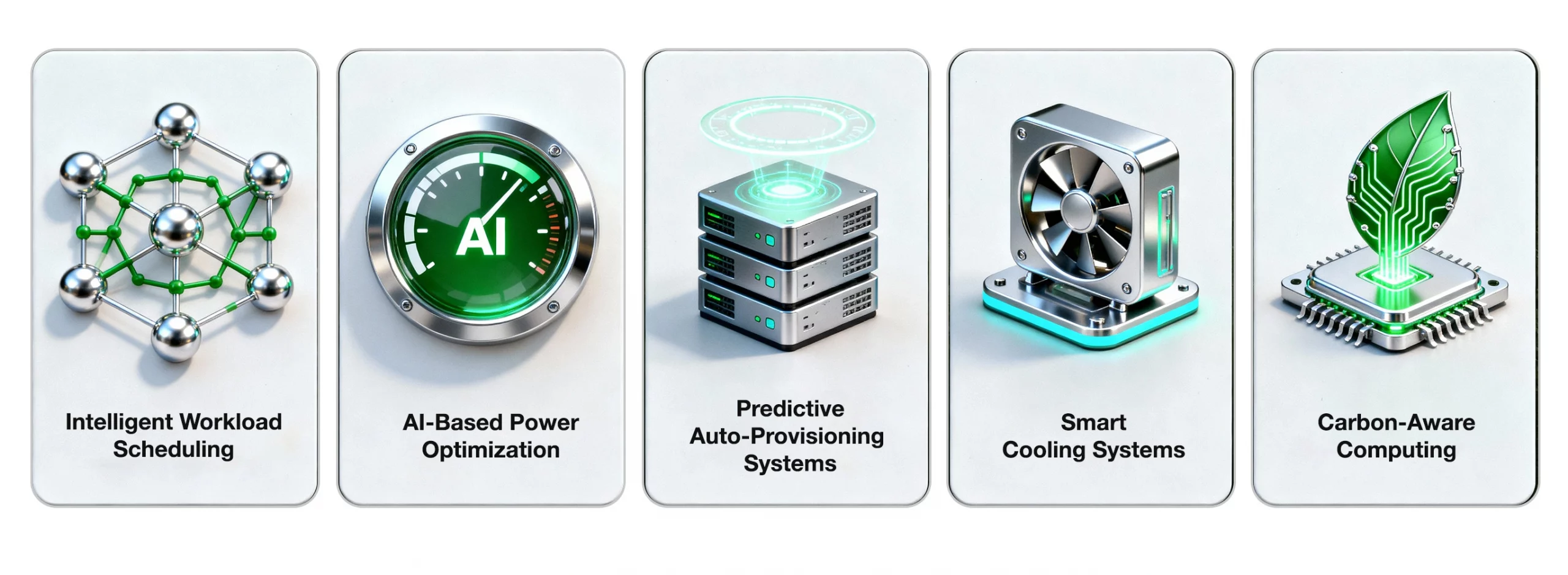
Intelligent Workload Scheduling
Utilizing AI software development services in sustainable cloud or green cloud computing helps you dynamically assign workloads to only the most efficient servers or cloud regions. This will enable you to eliminate any idle computation and ensure optimal server performance while minimizing the total energy consumption levels.
Real-World Example: Microsoft’s Azure uses this AI-driven workload scheduling approach. Using this, it manages and distributes various infrastructure tasks across regions that have a higher renewable energy availability.
AI-Based Power Optimization
AI also provides continuous power monitoring capabilities and helps you identify cloud optimization opportunities in real-time across data centers and cloud infrastructure. It does this by analyzing, predicting the demand, and then automatically adjusting power usage for servers. This helps you reduce energy usage when needed, while maintaining performance and efficiency.
Real-World Example: DeepMind AI manages power distribution and also reduces the overall energy consumption up to 40%.
Predictive Auto-Provisioning Systems
AI can predict traffic patterns and identify any usage spikes with the help of predictive data analytics capabilities. This enables your system to immediately check which cloud resources are unnecessary or underutilized, and AI will help you in scaling them up or down automatically.
By adjusting resources dynamically, predictive auto-provisioning systems help reduce waste and optimize the cloud resource performance, and ultimately lower the overall operational costs.
Real-World Example: Netflix’s Scryer engine uses predictive analytics to automatically scale up or down server resources when anticipated high traffic or when you need to save on costs.
Smart Cooling Systems
AI helps you optimize your data center cooling systems by analyzing temperature, airflow, and humidity in real time. By continuously monitoring these parameters, AI can adjust cooling intensity levels dynamically, prevent overcooling, and reduce the overall energy consumption.
Furthermore, you can hire mobile app developers who have expertise in cloud, helping you leverage sustainable and intelligent cloud practices into your existing infrastructure.
Real-World Example: Alibaba Cloud uses AI-driven cooling and monitors their server racks, which helps it adjust airflow automatically.
Carbon-Aware Computing
One of the most helpful AI innovations in green cloud computing is carbon-aware computing and workload shifting. AI monitors the carbon intensity levels and identifies cloud regions or a particular time period where the carbon intensity levels are low. If the energy is cleaner and levels are low, then it helps you in automatically shifting workloads, such as batch processing, to low-carbon regions or times.
Moreover, you can consider partnering with an AI app development company that has a special expertise in green cloud computing. With their brilliant skillset, they can ensure that your apps or systems are both efficient and environmentally sustainable.
Real-World Example: Google Cloud’s load shifting system is designed with this carbon-aware computing approach and helps direct non-urgent workloads to low-carbon regions.
Read Also: Green App Development for Startups
Sustainable Cloud Adoption: A Practical Step-by-Step Roadmap
Here’s a practical and strategic roadmap that you can follow while adopting green cloud sustainability:
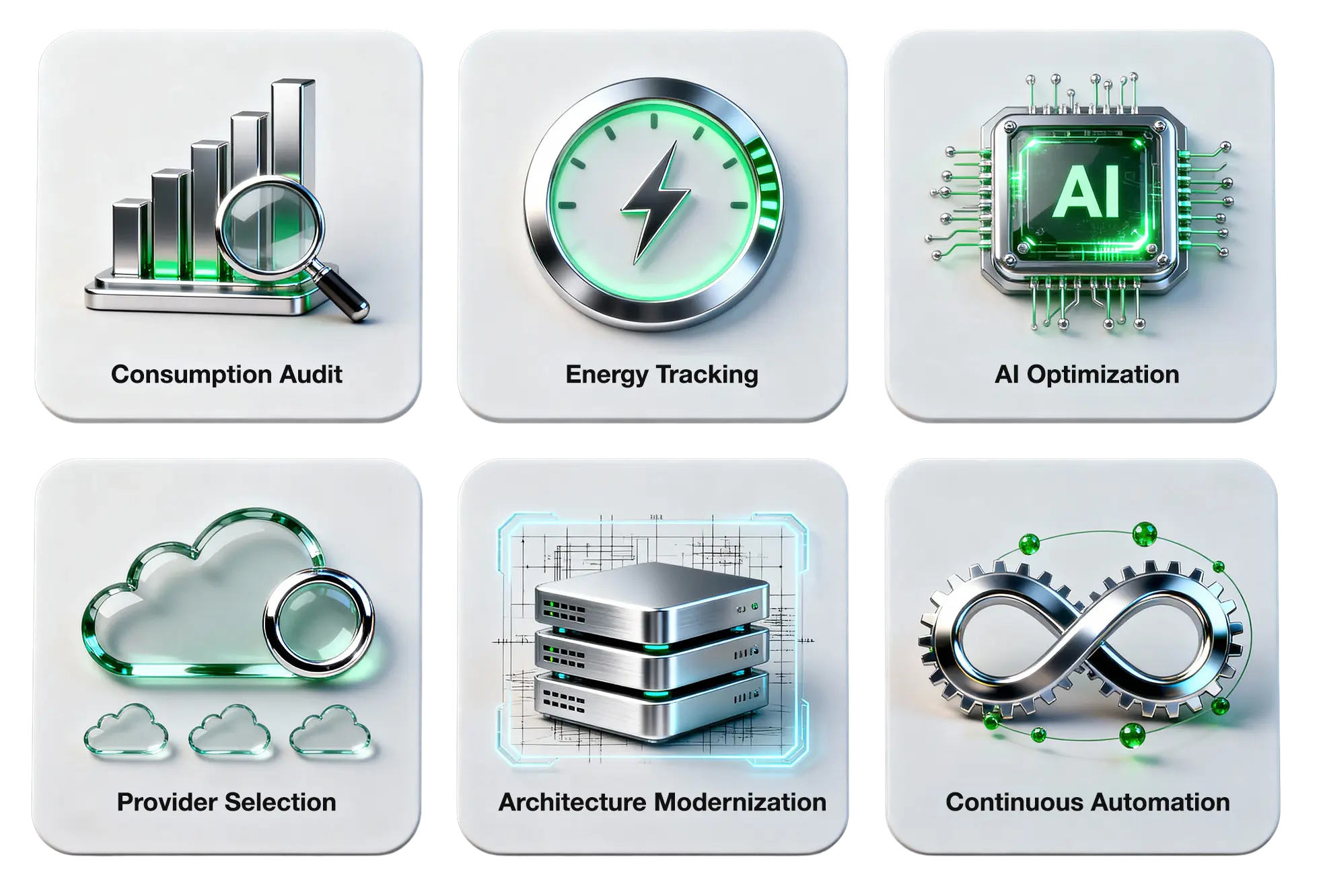
Step 1: Measure your Current Consumption
This step begins with assessing the existing cloud environment and identifying the total carbon footprint consumption. You need to identify the areas where most of your storage or network energy is being consumed. Also, while understanding the current carbon footprint, look for idle bases or architectures that are currently inefficient or underutilized.
You can consider partnering with an experienced custom app development company that specializes in cloud optimization. They can help you perform detailed and in-depth audits, resulting in faster identification of inefficiencies.
Step 2: Implement Energy Tracking Tools
After assessing the current consumption status, you need to leverage some third-party monitoring tools that offer real-time capabilities. These cloud-native monitoring tools help you know the power consumption per workload and estimate the total carbon emission levels.
Using these tools, you can quantify your application or systems. This will help you in making suitable data-driven decisions toward ESG (environmental, social, and governance) goals.
Step 3: Leverage Artificial Intelligence Optimization
This step involves the usage of AI tools such as intelligent auto-scaling to adjust the resource allocation whenever in demand and anomaly detection to find unusual energy consumption spikes. Moreover, by integrating AI, you can also use predictive analytics to forecast workload patterns and predict the areas where the energy is consumed at maximum or at lowest.
This approach helps you improve energy efficiency and cost optimization of your systems or apps. Partnering with experts offering product development services can ensure that your business has a seamless AI integration into your existing cloud ecosystem.
Step 4: Choose a Cloud Provider
After leveraging AI, this step involves choosing the right cloud provider and cloud deployment model, from public, private & hybrid, to multi-cloud. Your ultimate goal should be to ensure that your chosen provider aligns with your sustainability and performance goals.
Additionally, evaluating factors like regional availability, compliance requirements, pricing flexibility, etc, will help you set a foundation that is truly efficient and provides an eco-friendly cloud ecosystem.
Step 5: Adopt Modernized Architectures
Adopting modern architectures is the next step toward building an energy-efficient ecosystem. This step involves transitioning from traditional monolithic systems to serverless computing or microservices. These architectures utilize fewer resources, run only when necessary, and minimize environmental impact.
You can take expert suggestions from a reliable cloud application development company to ensure a seamless transition from traditional systems to modernized architectures.
Step 6: Automate & Continuously Monitor
Sustainability is not a one-time activity; in fact, it requires continuous optimization. This final step ensures that your cloud environment’s sustainability remains effective for a longer time.
As workloads, traffic patterns, or any resource demands keep evolving, you need to continuously monitor tools. This way, you can track power usage and carbon emissions levels. It will help you quickly identify inefficiencies, eliminate idle resources, and maintain a cost-effective cloud ecosystem.
If you are still uncertain about how to begin your green cloud journey, you can partner with a cloud-based application development company that has expertise in green cloud solutions.
Future Outlook: Strategic Trends Transforming the Cloud Industry
As organisations increasingly rely on cloud technologies to improve efficiency and scalability, green cloud sustainability practices are becoming a top priority for many organisations.
This aims to reduce energy usage and carbon footprint, which are associated with the usage of cloud services and resources. In the upcoming years, and in 2026, we can surely see cloud providers going toward the following strategic cloud computing trends:
- Zero-Carbon Infrastructures: Providers can ensure carbon-free cloud operations by entirely relying on renewable energy sources.
- Photonic Data Centers: Light-based photonic chips can replace traditional electrical computing, helping you to reduce heat output and lower energy consumption.
- Green FinOps: Organisations can integrate carbon metrics into financial operations, allowing their teams to optimise workloads and reduce the environmental impact.
Wrapping Up
To conclude this, the path to sustainability remains clear. With the rise in cloud adoption, embracing green cloud practices is no longer an optional achievement for businesses. It has become a new norm in the modern IT services and IT consulting industry. However, before moving to a green cloud strategy, you must evaluate your current cloud consumption and adopt the right AI tools that will completely resonate with your sustainable and performance goals.
By integrating AI innovations such as AI-driven optimization and continuous monitoring within your green cloud strategy, you can lower energy usage and reduce your operational costs. This will also help you build cloud ecosystems that don’t have a negative environmental impact, leading to gaining a significant advantage and contributing to a greener digital future.

FAQs
1. What is Green Cloud Sustainability?
Green cloud sustainability refers to the practice of designing, operating, and managing a cloud environment such that the total energy consumption is optimized and minimized. This is done so that there is no negative impact of your cloud services on the environment. Organizations can leverage cloud app development services to build optimized and energy-efficient infrastructure that reduces the overall carbon emission levels.
2. Why sustainable cloud adoption matters for organisations?
With the rising data usage and dependency on cloud services, organizations face challenges such as high operational costs and increased carbon footprints. This is where sustainable cloud practices came as a game-changer solution, helping you cut energy wastage and also reduce the overall costs.
3. How does AI improve Green Cloud Sustainability?
AI integrated within your green cloud architecture or system can be a crucial aspect for moving ahead in this competitive app development industry. AI helps you predict workload spikes, distribute cloud resources based on low-carbon regions or time periods, and improve cooling systems.
4. What are the top benefits of adopting a green cloud strategy?
Some of the key benefits of adopting a green cloud strategy for businesses are as follows:
- Lower Operational Costs
- Reduced Energy Usage
- Improved Cloud System Efficiencies
- Better Workload Performance
- Increased User Trust