Introduction — quick answer, why this matters
The answer is: If you’re starting out, the fastest way to get meaningful exposure is to focus on a short list of proven plays in India’s chip ecosystem — companies like CG Power, Bharat Electronics (BEL), Dixon Technologies, Kaynes Technology and MosChip — while you learn the sector. This post draws on an in-depth research report and on my 17+ years running StockManiacs.net, where I’ve helped 20,000+ traders learn technical analysis and build practical watchlists. The attached research report is the basis for the top semiconductor stocks in NSE and financial excerpts used here.
If you typed top semiconductor stocks in nse into Google, you’re probably confused by a flood of lists, buzzwords (PLI, OSAT, fab) and shiny returns. That’s normal. Semiconductors are a technical, cyclical industry — and Indian names range from defensive government-backed firms to small, fast-growing specialists. This guide gives you a simple, step-by-step path to understand the top semiconductor stocks in nse, the risks, and how to build a beginner-friendly position with a long-term lens.
What you’ll get in this post:
- A short, practical list of the best starting names among top semiconductor stocks in nse.
- A beginner portfolio plan you can follow with ₹10,000 or ₹50,000.
- A clear checklist to spot potential multibaggers.
- Tools, metrics and real examples from the research report and Q1 FY26 results.
Read on — every section is a mini guide you can skim or deep-read.
What are the top semiconductor stocks in NSE for beginners — and why?
The answer is: Start with a focused watchlist: CG Power, BEL, Dixon Technologies, Kaynes Technology and MosChip. These represent different parts of the value chain — power & infrastructure, defense electronics, EMS/contract manufacturing, OSAT (assembly & test), and chip design. The attached research report highlights these as the top 5 for 2025–26 and explains the rationale behind each choice.
Quick snapshot (one line each):
- CG Power & Industrial Solutions — large order book, power systems expertise, moving into assembly/OSAT; good for capex play.
- Bharat Electronics (BEL) — government-backed defense electronics leader; defensive semiconductor exposure.
- Dixon Technologies — leading EMS partner to global brands; benefits from PLI and export demand.
- Kaynes Technology — pure-play OSAT; first made-in-India chip ambitions and rising margins.
- MosChip Technologies — semiconductor design/IP services; high growth potential but higher volatility.
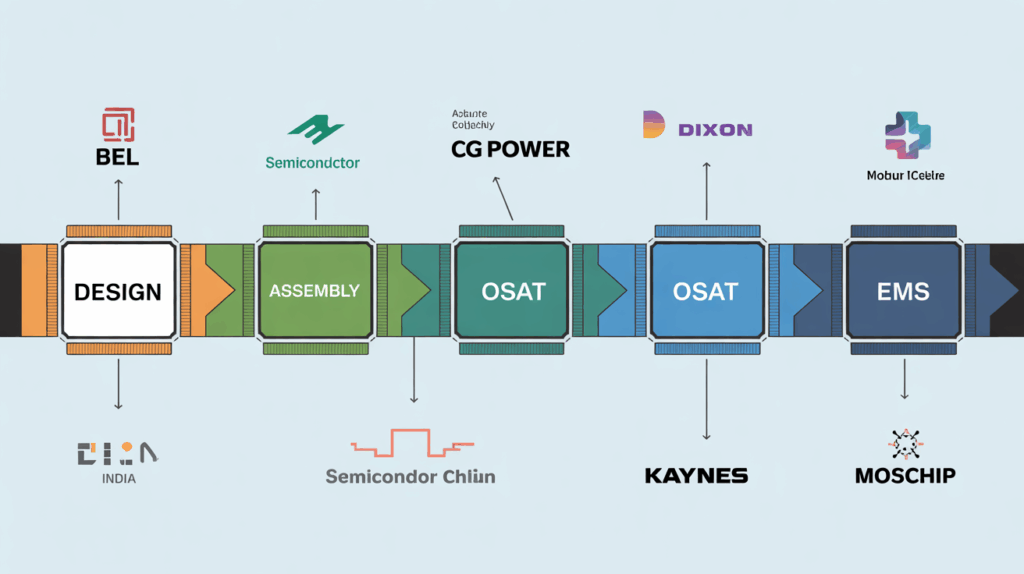
Why these five? The research report shows evidence: order books, Q1 FY26 revenue/profit beats for several names, PLI scheme advantages and real partnerships with global OEMs. These are the kinds of signals that matter when filtering the 30+ listed names on NSE and BSE.
Beginner case (real-style example): Priya, a new investor, opened a watchlist with the five names above. She tracked quarterly updates and order inflows for two months. On a 10% correction, she scaled into Dixon and Kaynes and used small allocations for the smaller-cap MosChip. Two quarters later, strong Q1 FY26 results (documented in the report) validated her thesis and reduced her anxiety — because she had spread risk across the value chain rather than placing all hopes on one “chip hero.”
How to build a beginner-friendly portfolio of these semiconductor stocks with ₹10,000
The answer is: Use a staggered, allocation-aware plan: diversify across 2–4 names, buy in tranches, and keep initial exposure small (max 10–15% of total equity savings). Treat semiconductor picks as growth exposure, not your emergency fund.

Zero to Stock Hero
₹149 ₹199
Download

Wealth Multiplier
₹249 ₹299
Download

Multibagger Wealth
₹249 ₹299
Download

Technical Analysis
₹249 ₹299
Download

5-in-1 Mega Bundle
₹649 ₹1,345
Download
Step-by-step:
- Decide allocation: For ₹10,000, consider splitting: 40% into a large/defensive name (BEL or CG Power), 40% into a growth/EMS name (Dixon), and 20% into a high-upside small-cap (MosChip).
- Stagger buys: Buy 1/3 immediately, 1/3 on a 5–8% dip, 1/3 over next 2 months. This reduces timing risk.
- Use a stop/mental stop: For small accounts, prefer mental stop-loss (e.g., re-evaluate if down 20% and fundamentals worsen).
- Rebalance quarterly: If one stock runs up 50% and becomes >40% of your semiconductor bucket, consider booking partial gains.
- Hold horizon: Minimum 12–18 months for these picks — many projects, fabs and PLI benefits play out over quarters.
Example allocation table (₹10,000):
- BEL — ₹4,000
- Dixon — ₹4,000
- MosChip — ₹2,000
Short story (hypothetical): Asha invested ₹10,000 as above. When Dixon reported 95% YoY revenue growth in Q1 FY26 (as highlighted in the research report), her ₹4k position jumped and she booked 20% gains, reinvesting some into Kaynes on the same day. This is a practical, low-stress way to compound small wins.
Tip: Use broker fractional investing where available or buy small lot sizes. Keep transaction costs low by using discount brokers I partner with (Zerodha, Upstox, Fyers).
What are the main risks when buying top semiconductor stocks in NSE — and how to manage them?
The answer is: Expect volatility. Key risks are execution delays, cyclicality, stretched valuations and competition. Manage risk by diversification, position sizing and active monitoring of order books & PLI status.
Main risks explained simply:
- Execution Risk: New fabs and OSAT units take time. Delays can sap investor patience and hurt stock prices. (Analogy: building a new factory is like planting an orchard — you’ll not harvest apples immediately.)
- Cyclical Demand: Chip demand rises/falls with global cycles (phones, EVs, AI servers). Stocks swing more than index names.
- Valuation Risk: Some small caps trade on future growth; if growth slips, valuations compress fast.
- Geopolitical/Supply Chain Risk: Global tensions or component shortages affect order flows.
- Single-customer Concentration: EMS companies sometimes depend on a few large clients — losing one can dent revenue.
Practical mitigation:
- Diversify across the value chain: Mix design (MosChip), OSAT (Kaynes), EMS (Dixon), and defensive (BEL).
- Limit sector exposure: Keep semiconductor allocation to 15–20% of equity portfolio as recommended in the research report.
- Watch orderbooks, PLI mentions and earnings: These are early signs of delivery risk or acceleration.
- Use staggered buys and set rules for adding on corrections (10–15% dips suggested by the report).
Real example from the report: CG Power’s large orderbook provides multi-year revenue visibility, which reduces execution risk relative to a pure small-cap design firm. Use scale in companies with strong orderbooks if you prefer lower downside risk.
How to spot potential multibaggers among semiconductor stocks on the NSE
The answer is: Look for a combination of strong order books, PLI / government incentives, rising margins, unique IP or services, and credible global partnerships — then size positions appropriately for risk. If you focus on these signals, you’ll increase the odds of finding potential multibaggers.
A practical checklist (score each on a 1–5 scale):
- Order book growth / visibility (years of revenue covered).
- Revenue & PAT growth trajectory (Q-on-Q and YoY acceleration).
- Margin expansion (improving EBITDA and ROE).
- Government/PLI linkages (policy tailwinds unlock faster capex).
- Unique tech/IP or design capability (hard to replicate).
- Customer diversification (not over-reliant on single client).
Why this works: Multibaggers in hardware often appear when a small company wins long-term contracts (order book), scales production (margins improve) and rides a structural policy tailwind (PLI or India Semiconductor Mission funding).

Case from the report: Kaynes shows order book growth (47% YoY) and is positioning as an OSAT pioneer; the report flags it as a potential multibagger because it combines real orders, margin expansion and first-mover advantage in India’s assembly & test space.
Mini calculation example (hypothetical): If a small design firm grows revenue from ₹100 crore to ₹300 crore in 3 years and its operating margin expands from 8% to 16%, PAT could increase 6x. A 6x earnings increase often leads to multi-bag returns if the market maintains or rewards higher multiples. That’s the math behind a multibagger — not fairy dust.
Remember: For every multibagger, there are companies that fail to execute. Use small, managed bets.
The answer is: Use a mix of fundamental screens (order book, revenue growth, margins, ROE), news/announcements (PLI, MoUs), and simple technical signals to manage entry — and rely on trusted trackers like Screener.in, Moneycontrol, and sector lists while you learn. I’ve built and tested many of these tools on StockManiacs.net and use them when mentoring new traders.
Essential metrics explained:
- Order Book / Backlog: Tells you how much business is already booked — useful for execution visibility.
- Revenue & PAT Growth (YoY & QoQ): Look for consistent acceleration, not one-off spikes.
- ROE & ROCE: Gauge capital efficiency. High ROE often correlates with strong returns.
- EBITDA Margin Expansion: Indicates operational improvement.
- PLI / Government Support Exposure: Companies that qualify enjoy subsidies and faster capex economics.
- Client & Product Mix: Prefer diversified customer bases and proprietary products or design IP.
Practical tooling:
- Screener.in — quick fundamental screen templates (ROE, PEG, revenue growth).
- TradingView / Broker Charts — for basic technical entries, trend identification and stop placement.
- Company filings & investor presentations — primary source for order book and project timelines.
- My own tools (e.g., pivot calculators, watchlist templates) — useful for managing entries and exits.
Tool use case (real-style): When Dixon reported a 95% revenue jump in Q1 FY26 (noted in the research report), I used Screener.in to validate margin improvement and TradingView to watch for a disciplined re-entry on consolidation. The combination reduced my downside and let me scale in with confidence.
Practical step-by-step strategy to buy your first semiconductor stock on NSE
The answer is: Follow a simple 7-step checklist: open an account, create a 5-stock watchlist, set allocation rules, pick entry strategy (staggered buys), place orders with sensible stops, monitor quarterly triggers, and review every quarter. This practical flow works for beginners and scales with experience.
Seven steps in plain language:
- Open a discount broker account (Zerodha / Upstox / Fyers). Keep costs low.
- Build a 5-stock watchlist — include the top five from the report plus a defensive name. Label them by role: defensive / growth / high-upside.
- Decide allocation — treat semiconductors as a growth sleeve (max 15–20% of equities).
- Choose an entry plan — stagger buy (1/3 now, 1/3 on 5–10% dip, 1/3 over 2 months) or value averaging.
- Place orders and set rules — no emotional doubling down; only add on fundamentals-backed dips.
- Monitor quarterly triggers — orderbook inflows, PLI confirmation, margin expansion, client wins. These are your green lights.
- Exit rules — trim on target (partial booking at set gains) or re-evaluate if fundamentals break (e.g., orderbook cut by >25%).
Example timeline (Rohit’s first buy): Rohit opened an account and placed a staggered buy for Dixon after checking Q1 FY26 earnings. He set a target to book 30% gains on half the position and hold the rest for 12–18 months. This approach reduced stress and kept decisions rule-based.
Pro tip: Keep a spreadsheet with columns: stock, role, buy dates, lot sizes, targets, stop-loss, and quarterly notes. I use similar templates when coaching new traders at StockManiacs.
Conclusion — clear next steps and recommended quick checklist
The answer is: Start small, diversify across the semiconductor value chain, focus on order books and government/PLI links, and use a staged buy plan. The attached research report is a practical reference for the top names and entry ranges.
Quick recap (actionable checklist you can use today):
- Create a 5-stock watchlist with the report’s top picks (CG Power, BEL, Dixon, Kaynes, MosChip).
- Allocate carefully: semiconductor exposure = 15–20% of your equity portfolio.
- Buy in tranches over 3 months; use corrections (10–15%) to add.
- Measure fundamentals: watch orderbook growth, ROE, margin expansion and PLI exposure.
- Keep a 12–18 month horizon for each position; be ready for volatility.
- Rebalance quarterly and book partial profits when targets are hit.
Final story to anchor this: I once advised a small group of traders to split their sector bet across three names — an EMS firm, an OSAT player and a design firm. One year later, the EMS and OSAT delivers strong revenue growth and the design firm doubled after winning a key IP contract. None of the winners were obvious at the start, but the diversified approach and focus on real order books produced strong outcomes.
If you’re new, treat the top semiconductor stocks in nse list as a learning field. Use small positions. Read quarterly filings and look for the concrete signs discussed here. Over time, you’ll develop an intuitive sense for potential multibaggers while avoiding single-stock risk.
Good luck — and if you want a ready-to-use watchlist spreadsheet or a one-page checklist I use with new clients, you can replicate the process above and start tracking your first semiconductor picks today.