The “data-scientist” job posting is quietly disappearing from corporate career pages. In its place, you’ll find a title that didn’t exist three years ago: GenAI Data Scientist. A search on LinkedIn Jobs as of today returns around 18,000 open roles that explicitly demand “LLM fine-tuning”, “prompt evaluation”, or “synthetic data generation”, as one of the skills for the position. AI-related job postings have grown at an average annual rate of nearly 29% over the last 15 years, which outpaces the 11% annual growth rate of job postings in the general economy. The message is blunt: employers still need people who can squeeze insight from data, but they expect those people to do it with foundation models, not just logistic regression.
This challenges the traditional data-science toolkit and career path. The rest of this article focuses on the new skills, workflows, and team structures you can adopt to thrive in the GenAI era.
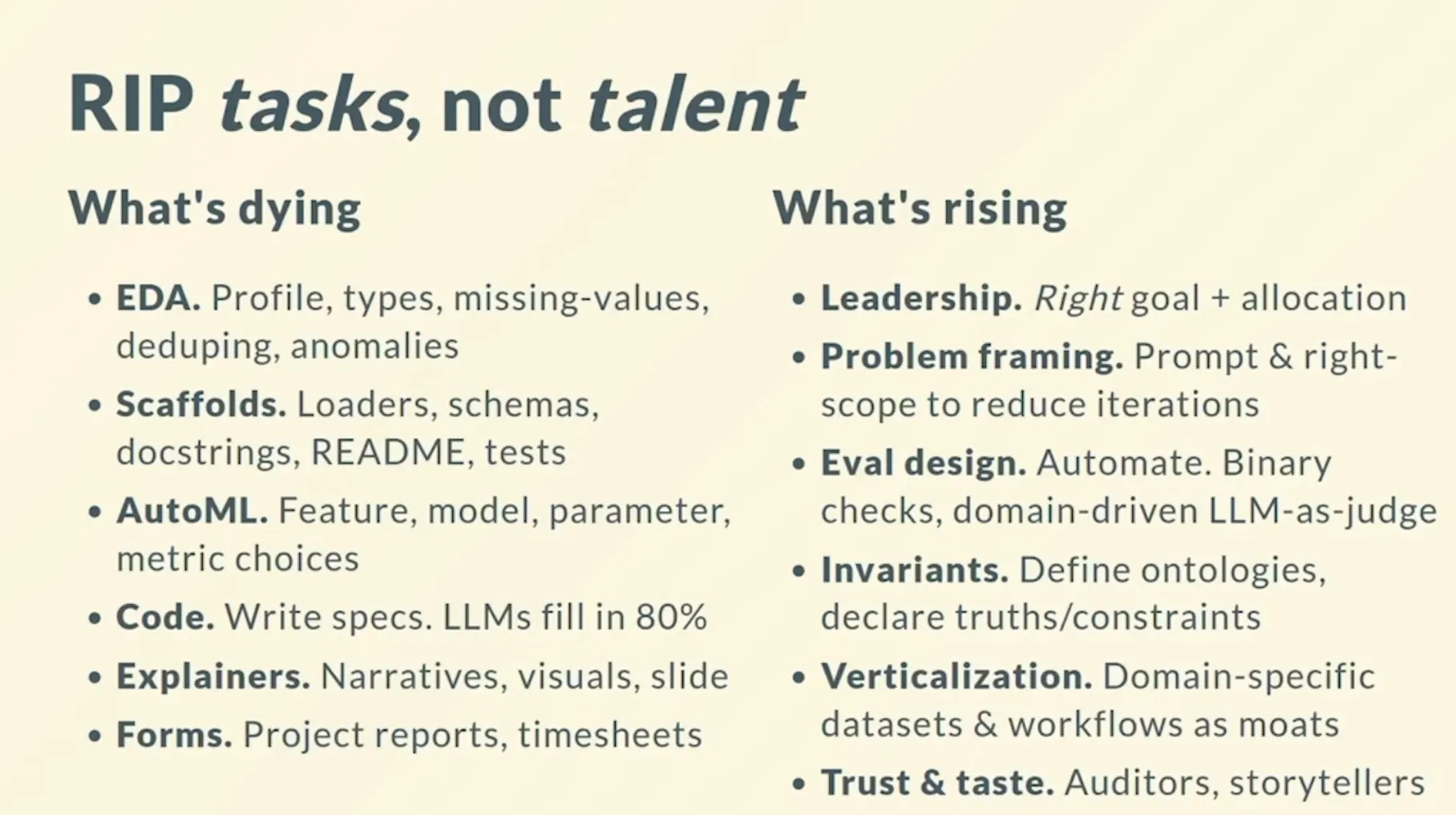
The article has been inspired by a talk on the topic RIP, Data Scientists by Anand S, in DHS 2025.

No longer the MC!
No one actually laid data scientists to rest; they just stopped being the main character.
The dashboards we once heroically deployed now answer themselves. Executives who used to beg for forecasts are now prompting ChatGPT for “three-year revenue scenarios in the style of McKinsey.” The romance of the Jupyter notebook is gone—replaced by a browser tab that writes the notebook for you.

You might be thinking, what would happen to the workload traditionally associated with data scientists? Data Scientists basically work with data in this manner:
- Explore it
- Clean it
- Model it
- Explain it
- Deploy it
- Anonymise it.
But that’s of the past now. Recruiters no longer ask “Can you build a Random Forest?”. Instead, they ask:
- “How do you stop an LLM from hallucinating price quotes in front of a client?”
- “What guardrail metric do you monitor after each fine-tune?”
- “Show me the model card that convinced Legal to ship.”
A 2025 analysis of 1,200 hired résumés shows the must-have line-items for a “GenAI Data Scientist” role:
| Technical skill | % of offers that mention it |
|---|---|
| Prompt engineering / eval frameworks | 97 % |
| LLM fine-tuning (LoRA, QLoRA) | 91 % |
| Retrieval-augmented generation (RAG) | 89 % |
| Synthetic-data generation for small-data problems | 72 % |
| Statistical rigor (causal inference, uncertainty quant.) | 68 % (still alive) |
| MLOps (CI/CD for models) | 65 % |
Notice what is absent: Kaggle medals, Tableau dashboards, pure research credentials.
Notice what is retained: statistics, because someone still has to prove the new pipeline beats the old one.
Salary & hiring data
Lightcast’s August 2025 report for U.S. roles has the following:
| Title | Median base salary | YoY growth in postings |
|---|---|---|
| Data Scientist (generic) | USD 125k | –28% |
| Generative-AI Data Scientist | USD 155k | +310% |
| LLM Product Data Scientist | USD 165k | +260% |
There is a clear overpay for AI-driven roles over basic Data Scientist. Companies pay the premium because the cost of getting generative systems wrong is public and immediate: regulatory fines (EU AI Act), brand damage (airline chatbot giving away discounts), or compute bills that scale with every badly formulated prompt.
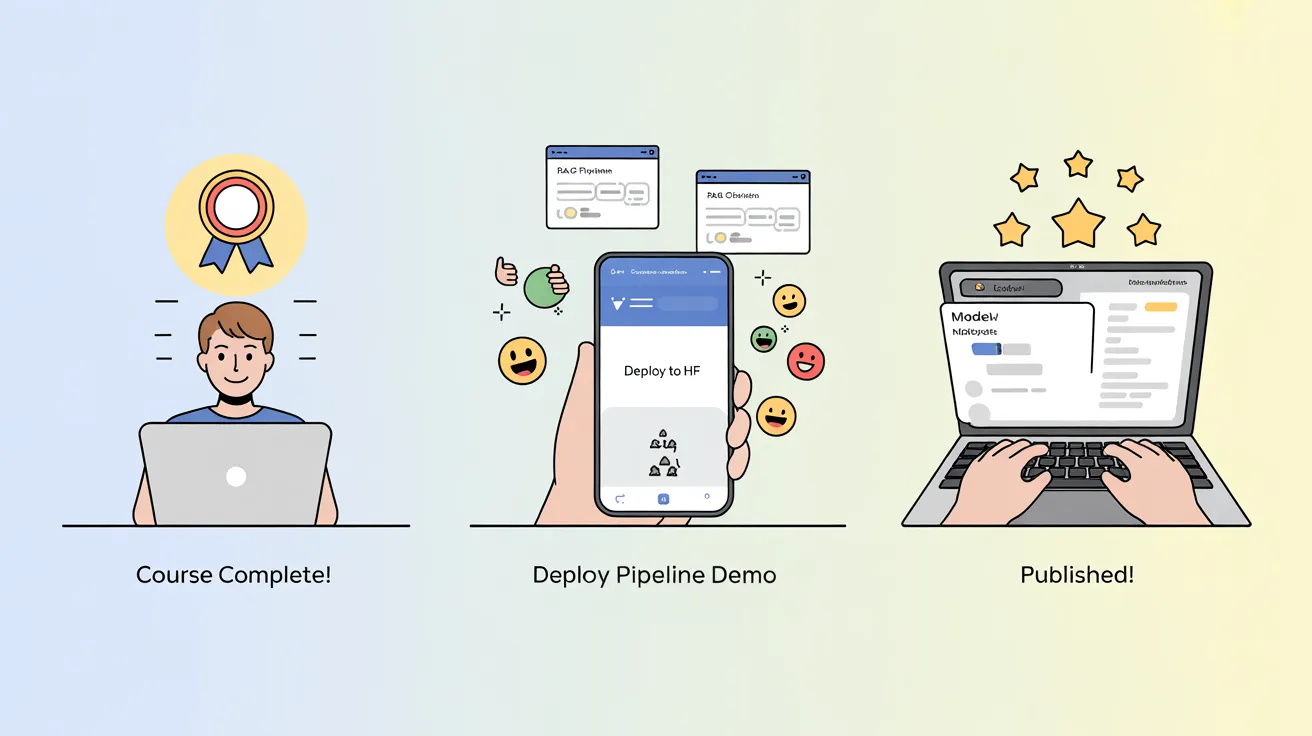
1. Week 1-2: Finish a short, credentialed course
2. Week 3-6: Build a mini product
- Pick a business problem your current company already has (FAQ overload, report generation, etc.).
- Ship a RAG pipeline + guardrails; record real usage metrics (latency, answer accuracy, user thumbs-up).
- Host the demo on Hugging Face Spaces. This is because recruiters prefer links, not PDFs.
3. Week 7-12: Publish the artefacts
- Write a one-page model card (dataset, limitations, bias eval).
- Open-source the prompt-evaluation harness; get two GitHub stars if nothing else.
- Add a bullet to your résumé with quantified impact: “Reduced support-ticket volume 18%; model runs <500 ms @ USD 0.002 per query.”
The Résumé Makeover
Old headline: “Data Scientist | Python, R, scikit-learn, Tableau”
New headline: “I turn questions into products, products into insights, and insights into stories people believe.”
The bullet points shrink; the portfolio explodes with interactive demos, synthetic data cards, and model-cards that read like graphic novels. Recruiters don’t ask for your Kaggle rank; they ask for your funniest prompt that still passes the safety filter.
Conclusion
The data-science job is not dying; the umbrella is shrinking, while a new one, GenAI data science, is opening right beside it, offering higher pay, faster growth, and clearer production expectations. Statistical rigor plus prompt-era engineering is the hybrid skill set that commands a 20-30 % salary premium today and will likely be table stakes tomorrow. Retool once, and you future-proof the next decade.
Frequently Asked Questions
A. It’s being replaced by “GenAI Data Scientist,” a role focused on LLM fine-tuning, prompt evaluation, and synthetic data—skills rarely mentioned in 2022 postings.
A. Prompt engineering (97%), LLM fine-tuning (91%), RAG (89%), synthetic data generation (72%), statistics (68%), and MLOps (65%).
A. In the U.S., generic Data Scientists earn ~$125k (down 28%), while Generative-AI Data Scientists earn ~$155k and LLM Product Data Scientists ~$165k, both with >250% posting growth.
A. Take a short AI course, ship a mini RAG product with guardrails, and publish artefacts like model cards and open-source tools to demonstrate real-world impact.
A. Statistical rigor—causal inference, uncertainty quantification—remains essential to prove that new generative pipelines actually outperform older methods.

I specialize in reviewing and refining AI-driven research, technical documentation, and content related to emerging AI technologies. My experience spans AI model training, data analysis, and information retrieval, allowing me to craft content that is both technically accurate and accessible.
Login to continue reading and enjoy expert-curated content.