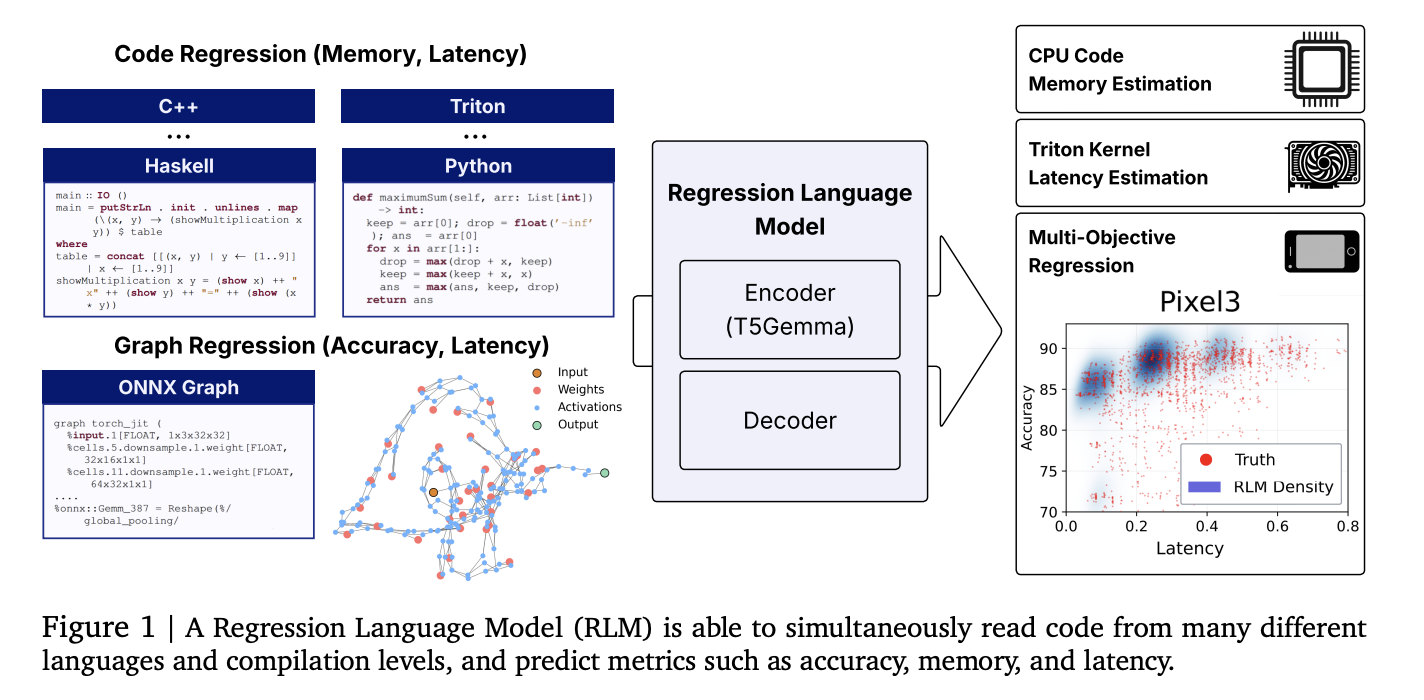
Researchers from Cornell and Google introduce a unified Regression Language Model (RLM) that predicts numeric outcomes directly from code strings—covering GPU kernel latency, program memory usage, and even neural network accuracy and latency—without hand-engineered features. A 300M-parameter encoder–decoder initialized from T5-Gemma achieves strong rank correlations across heterogeneous tasks and languages, using a single text-to-number decoder that emits digits with constrained decoding.
What exactly is new?
- Unified code-to-metric regression: One RLM predicts (i) peak memory from high-level code (Python/C/C++ and more), (ii) latency for Triton GPU kernels, and (iii) accuracy and hardware-specific latency from ONNX graphs—by reading raw text representations and decoding numeric outputs. No feature engineering, graph encoders, or zero-cost proxies are required.
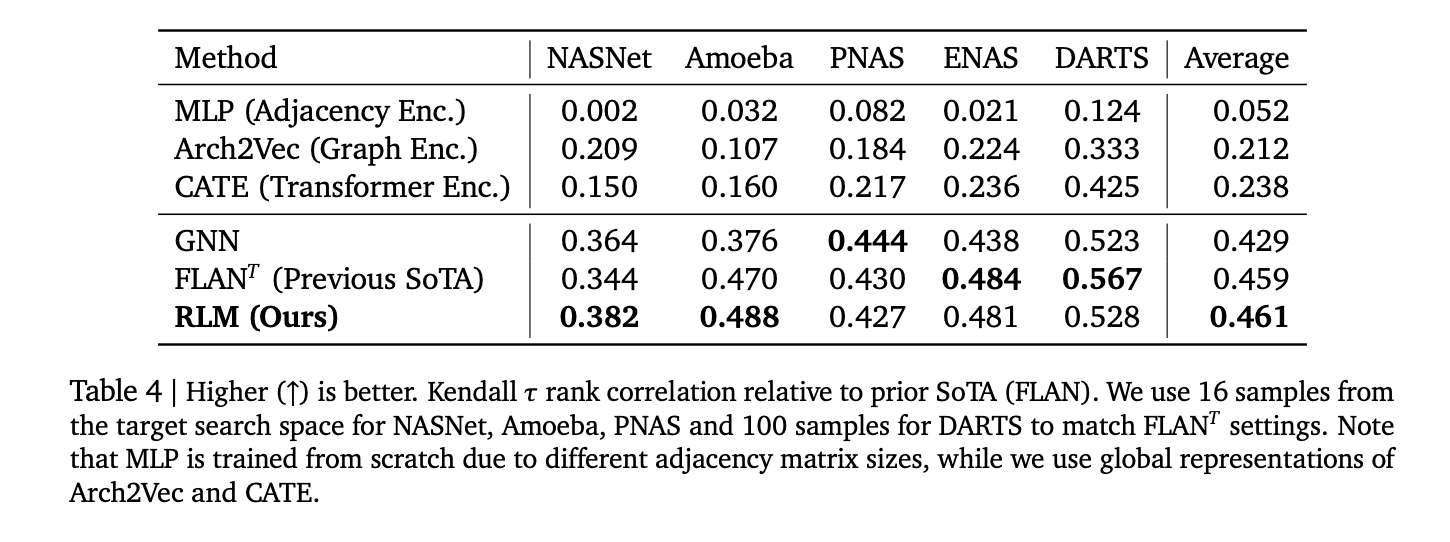
- Concrete results: Reported correlations include Spearman ρ ≈ 0.93 on APPS LeetCode memory, ρ ≈ 0.52 for Triton kernel latency, ρ > 0.5 average across 17 CodeNet languages, and Kendall τ ≈ 0.46 across five classic NAS spaces—competitive with and in some cases surpassing graph-based predictors.
- Multi-objective decoding: Because the decoder is autoregressive, the model conditions later metrics on earlier ones (e.g., accuracy → per-device latencies), capturing realistic trade-offs along Pareto fronts.
Why is this important?
Performance prediction pipelines in compilers, GPU kernel selection, and NAS typically rely on bespoke features, syntax trees, or GNN encoders that are brittle to new ops/languages. Treating regression as next-token prediction over numbers standardizes the stack: tokenize inputs as plain text (source code, Triton IR, ONNX), then decode calibrated numeric strings digit-by-digit with constrained sampling. This reduces maintenance cost and improves transfer to new tasks via fine-tuning.
Data and benchmarks
- Code-Regression dataset (HF): Curated to support code-to-metric tasks spanning APPS/LeetCode runs, Triton kernel latencies (KernelBook-derived), and CodeNet memory footprints.
- NAS/ONNX suite: Architectures from NASBench-101/201, FBNet, Once-for-All (MB/PN/RN), Twopath, Hiaml, Inception, and NDS are exported to ONNX text to predict accuracy and device-specific latency.
How does it work?
- Backbone: Encoder–decoder with a T5-Gemma encoder initialization (~300M params). Inputs are raw strings (code or ONNX). Outputs are numbers emitted as sign/exponent/mantissa digit tokens; constrained decoding enforces valid numerals and supports uncertainty via sampling.
- Ablations: (i) Language pretraining accelerates convergence and improves Triton latency prediction; (ii) decoder-only numeric emission outperforms MSE regression heads even with y-normalization; (iii) learned tokenizers specialized for ONNX operators increase effective context; (iv) longer contexts help; (v) scaling to a larger Gemma encoder further improves correlation with adequate tuning.
- Training code. The regress-lm library provides text-to-text regression utilities, constrained decoding, and multi-task pretraining/fine-tuning recipes.
Stats that matters
- APPS (Python) memory: Spearman ρ > 0.9.
- CodeNet (17 languages) memory: average ρ > 0.5; strongest languages include C/C++ (~0.74–0.75).
- Triton kernels (A6000) latency: ρ ≈ 0.52.
- NAS ranking: average Kendall τ ≈ 0.46 across NASNet, Amoeba, PNAS, ENAS, DARTS; competitive with FLAN and GNN baselines.
Key Takeaways
- Unified code-to-metric regression works. A single ~300M-parameter T5Gemma-initialized model (“RLM”) predicts: (a) memory from high-level code, (b) Triton GPU kernel latency, and (c) model accuracy + device latency from ONNX—directly from text, no hand-engineered features.
- The research shows Spearman ρ > 0.9 on APPS memory, ≈0.52 on Triton latency, >0.5 average across 17 CodeNet languages, and Kendall-τ ≈ 0.46 on five NAS spaces.
- Numbers are decoded as text with constraints. Instead of a regression head, RLM emits numeric tokens with constrained decoding, enabling multi-metric, autoregressive outputs (e.g., accuracy followed by multi-device latencies) and uncertainty via sampling.
- The Code-Regression dataset unifies APPS/LeetCode memory, Triton kernel latency, and CodeNet memory; the regress-lm library provides the training/decoding stack.
It is very interesting how this work reframes performance prediction as text-to-number generation: a compact T5Gemma-initialized RLM reads source (Python/C++), Triton kernels, or ONNX graphs and emits calibrated numerics via constrained decoding. The reported correlations—APPS memory (ρ>0.9), Triton latency on RTX A6000 (~0.52), and NAS Kendall-τ ≈0.46—are strong enough to matter for compiler heuristics, kernel pruning, and multi-objective NAS triage without bespoke features or GNNs. The open dataset and library make replication straightforward and lower the barrier to fine-tuning on new hardware or languages.
Check out the Paper, GitHub Page and Dataset Card. Feel free to check out our GitHub Page for Tutorials, Codes and Notebooks. Also, feel free to follow us on Twitter and don’t forget to join our 100k+ ML SubReddit and Subscribe to our Newsletter. Wait! are you on telegram? now you can join us on telegram as well.

Asif Razzaq is the CEO of Marktechpost Media Inc.. As a visionary entrepreneur and engineer, Asif is committed to harnessing the potential of Artificial Intelligence for social good. His most recent endeavor is the launch of an Artificial Intelligence Media Platform, Marktechpost, which stands out for its in-depth coverage of machine learning and deep learning news that is both technically sound and easily understandable by a wide audience. The platform boasts of over 2 million monthly views, illustrating its popularity among audiences.