What if you could see whether a product idea will resonate even before investing heavily in development? What if design flaws surfaced in wireframes, not after launch? In product development, those “what ifs” are no longer unrealistic. All thanks to advances in AI for product development, teams are turning what used to be months of guesswork into weeks of tested, measurable insights.
Studies show that companies using AI tools in their R&D and development pipelines achieve 20–50% faster launches and see meaningful cost savings. When the pressure’s on, such as when market windows tighten, when competition heats up, those gains aren’t just nice to have. They’re survival.
This blog is for founders, product managers, and CTOs who want not just efficiency, but innovation; not just cheaper costs, but smarter decisions. We’ll cover key benefits, real-world use cases, cost trade-offs, and what you need to know to work with a product development company that really knows how to seamlessly integrate AI. So, stay tuned till the end for some useful insights :
Why AI Is Changing the Game in Product Development
In most organizations, product development often suffers from delays, misalignment, and waste. Teams build features nobody uses, wait weeks for feedback, or discover performance problems only late in QA. AI is changing that narrative.
1. Seeing the Invisible Early
AI can analyze user feedback, market trends, and prototypes to highlight gaps even before you build. Instead of launching on faith, you launch with some useful insight.
2. Doing More with Less Human Effort
Repetitive tasks such as writing spec docs, generating mockups, and running standard tests can take upto 30-50% of team time. AI tools offload a lot of that, so human creativity can focus on solving the real challenges or problems. All you need to do is invest in professional product development services to reduce repetitive tasks & time.
3. Better Roadmaps, Smarter Prioritization
With data flowing in from usage patterns, customer feedback, and even sentiment on forums, AI helps you pick the next most valuable feature. Product roadmap AI tools help ensure you invest where you’ll get returns, not just where ideas seem exciting.
Key Reasons Businesses Are Turning to AI for Product Development
Traditional product development has always been slow, resource-intensive, and prone to iteration fatigue. But AI integration in product development has changed that equation by bringing speed, accuracy, and data-backed decisions into every stage of creation.
- Time-to-Market Advantage
AI automates repetitive design and testing tasks. Thus, helping companies reduce time-to-market by up to 40%. Faster launches mean earlier customer feedback and higher competitiveness. - Smarter Product Decisions
Machine learning models analyze customer data to predict which features will perform best, turning product decisions from intuition-driven to data-driven insights. - Cost Optimization
Businesses can now reduce product development costs with AI by cutting manual labor, minimizing errors, and accelerating R&D cycles. Moreover, partnering with a top-notch product development company ensures these savings are maximized while maintaining high-quality outcomes. - R&D Acceleration
AI analyzes materials, performance metrics, and historical project data to shorten experimentation time. You can also discuss your project with a recognized AI app development company, which fuels R&D acceleration that keeps businesses ahead of industry trends.
How AI Transforms Product Development End-to-End
AI is now embedded across the entire product development lifecycle—from concept to customer feedback.
1. Ideation: Turning Data into Ideas
AI scans market trends, consumer behavior, and competitor products to suggest feature sets that align with real-world needs. In the digital product development process, several tools like ChatGPT, Jasper AI, and Notion AI assist in brainstorming product ideas that align with market gaps and customer expectations.
2. Design & Prototyping
Using AI-powered design systems and generative AI product development tools, designers can generate multiple UI variations in minutes. These designs adapt based on target audience personas, usability data, and previous product performance. Moreover, AI-driven tools like Figma AI and Uizard make AI-driven prototyping faster and more user-focused.
3. Product Roadmapping
Product roadmap AI tools help managers align features with business goals, budgets, and deadlines. AI predicts how specific product decisions will impact cost, delivery, and customer value. Thus, making roadmap planning more accurate and strategic.
4. Testing & Quality Assurance
AI-powered QA systems detect bugs, simulate real-world conditions, and predict potential product failures before launch. Automated test suites powered by agentic AI for product workflows continuously refine software stability. Thus, making software development services more reliable and efficient.
5. Market Launch & Post-Launch Optimization
AI tools track user feedback, analyze sentiment, and optimize pricing and marketing post-launch. Product development companies leverage predictive analytics to suggest updates or new features based on real user data, ensuring continuous improvement and higher engagement.
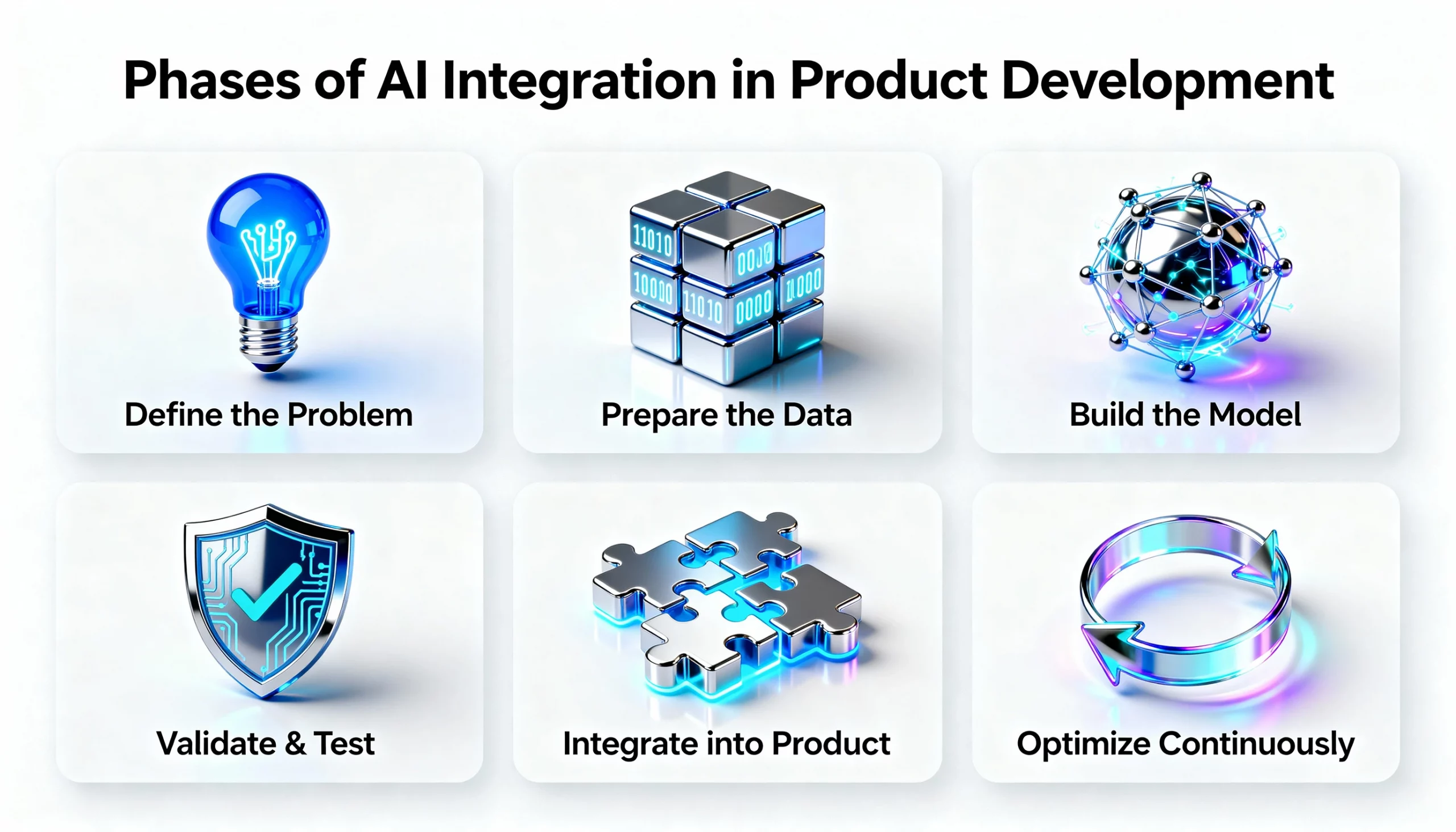
The AI Development Lifecycle: Phases of AI Integration in Product Development
Integrating AI into product development isn’t about adding one tool and calling it innovation. It’s a structured, iterative journey where data, design, and decisions come together to build intelligent systems that scale. Here’s how most successful teams approach it:
1. Strategy & Problem Definition
During the product delivery phase, before diving into data or tools, leaders start by identifying why they need AI.
Is it to reduce manual QA time, improve feature recommendations, or automate workflows? Clarity here defines the scope, helps estimate ROI, and prevents wasteful experimentation.
2. Data Collection & Preparation
AI feeds on data, but not all data is useful. Teams spend time identifying what’s available, cleaning it, labeling it, and organizing it for modeling. This stage usually takes longer than expected. Yet it’s the foundation of everything that follows.
3. Model Selection & Development
Once data is ready, teams experiment with algorithms or pre-trained AI models suited to their product. For instance, a leading UI/UX design agency might use generative AI to create interface prototypes, while a custom app development company might train models to predict user churn or engagement trends.
4. Testing & Validation
AI models need testing like any other feature. Teams measure accuracy, reliability, and fairness. This phase ensures predictions make sense in real-world conditions and not just in theory.
5. Integration with Product Workflows
The real magic happens here. AI moves from standalone scripts into your product’s workflow. It can sit inside your analytics dashboard, automate customer responses, or drive smart recommendations. Moreover, smooth integration ensures that AI enhances existing processes instead of disrupting them.
6. Continuous Learning & Optimization
AI systems improve as they learn. Once live, your model should keep evolving with new data and feedback loops. That’s why a top product development agency integrates AI as an ongoing, evolving component of the product, not a one-time launch.
Read Also: How to Build an Effective Go-To-Market Strategy for a Mobile App Product
What It Costs: What You Need to Budget & Prepare For
Integrating AI takes investment, planning, and ongoing care. Here’s what real product teams are seeing in terms of cost, and what you’ll likely deal with.
1. Talent & Skills
You’ll need people comfortable with data, machine learning, experiment design, and UX research powered by AI. That often means hiring ML engineers, data scientists, or partnering with a top-notch mobile app development company that already has these skills.
2. Tooling & Infrastructure
Data pipelines, cloud computation, generative design tools, and testing platforms are all tools that cost. Sometimes licensing is expensive, sometimes computation and storage are. Expect to budget not just for build time, but for training models, monitoring, and updating them.
3. Risk Buffer
AI projects have risks: inaccurate models, data drift, bias, regulatory or ethical issues. Add buffers for exploratory work and expect some missteps early.
4. Maintenance & Iteration
Once you launch, it’s not over. Models need retraining, feature fine-tuning, and feedback loops. The cost to maintain can be 10–20% of the initial development, depending on complexity. Availing professional cross platform app development services ensures consistent updates and performance across all devices and operating systems.
Real-World Use Cases: Stories That Prove It
Nothing persuades better than real examples. Here are companies showing how AI changes deliverables in product development.
Case: CrossML’s Eight-Week Health & Wellness App
A healthcare startup had a vision: personalized wellness tracking, daily routines, and wearable integration. They partnered with CrossML, mapped core features, built an MVP, tested, and launched in just eight weeks. The result of integrating AI in healthcare? A nearly 3× increase in user engagement, secure real-time tracking, and streamlined product delivery. The secret was focusing only on the features that matter, using AI-accelerated prototyping and agile feedback loops.
Case: Intel’s Pre-Silicon Validation
Building complex semiconductor products is expensive and time-consuming, especially when bugs emerge late. Intel applied AI to simulate and test in a “pre-silicon” phase, reducing validation workload, spotting design issues earlier, and cutting overall cycle times. The result: huge cost savings and reduced risk before physical prototypes even existed.
Case: Model-Based Strategy in Manufacturing
In sectors like manufacturing, every delay or rework is very expensive. Teams using AI-driven model-based approaches, virtual simulations of design, requirements, and test data are delivering products with fewer defects, less duplication of work, and much faster production cycles. One report estimates up to 50% time-to-market reduction and 30-plus percent savings in design & development costs when applying this strategy.
Measuring ROI: How You’ll Know It’s Working
To see whether adopting product development AI tools paid off, you need to track these metrics carefully :
- Time-to-Market Shrinkage: Did your development cycles become shorter? How many weeks did you eliminate?
- Feature Adoption / Engagement Rates: For features built using AI suggestions, are users using them? Are they “sticky”?
- Defect Rate or QA Load: Are there fewer bugs, fewer late-stage fixes, fewer support tickets?
- Cost Saved vs Extra Spend: How much did you spend extra on AI (tools, skills, infrastructure) vs how much you saved in rework, delays, or enhanced sales?
- Return from User Feedback / Iteration Speed: How fast can you implement changes based on real usage data?
Challenges & How to Navigate Them
Every AI project faces obstacles. Here’s what you’ll learn along the way and how to make it less challenging :
- Data That’s Messy, Incomplete, or Biased
If your user data is patchy, your insights may be misleading. Always audit data, work to fill gaps, and guard against bias. - Organizational Resistance
Teams used to old workflows may distrust AI-suggested changes. Make adoption gradual; show wins early; involve people in shaping AI roles. - Expectations vs Reality
Some stakeholders expect perfection overnight. AI helps, but it doesn’t remove trade-offs. Be transparent about what’s experimental, what’s proven. - Ethics, Privacy, Compliance
AI touches user data, sometimes intimately. Be sure your models respect privacy laws, explainability, and user expectations around fairness. Partnering with providers offering IT consulting services helps ensure your AI systems stay compliant, ethical, and transparent.
How to Get Started with AI in Product Development
If you want to bring this transformation to your team, here are the steps you can start with:
- Pick a small pilot project — not the whole product. Maybe test generative design, prototype iteration, or AI-based QA.
- Select tools and partners wisely — look for product development ai tools that have clear case studies; partner with agencies that understand your domain.
- Set success metrics up front — time saved, engagement lifted, fewer defects. Measure continuously.
- Invest in your team — train them, hire where needed, build skills in AI, data, and UX.
- Iterate and scale — once pilot shows progress, expand into more features: product roadmap, AI, agentic AI workflows, etc.
Wrapping Up
You don’t need to imagine a world where product development is faster, smarter, and less wasteful. That world is here already for companies leveraging AI-powered product development. So, if you’re a product leader, founder, or CTO, your move is simple: launch your AI pilot, pick tools that align with your strategy, focus on measurable outcomes, and lean into the learning. Because in product development, the real edge belongs to those who act with intelligence and not just speed.
FAQs
1. How does AI improve product development efficiency?
AI helps teams automate repetitive tasks, predict outcomes, and analyze massive datasets quickly. This leads to faster decision-making, fewer errors, and shorter development cycles. Many businesses use AI-driven prototyping and testing tools to cut weeks off traditional timelines.
2. What are the main benefits of using AI in product development?
AI simplifies complex processes, enhances design accuracy, and personalizes user experiences. It reduces development costs by optimizing resources and enables faster time-to-market. Businesses also gain better insights from predictive analytics and real-time data.
3. Is AI suitable for small startups or only for large enterprises?
AI is no longer limited to big tech players. With affordable AI tools for product development, startups can automate R&D, run quick MVP tests, and gather early customer feedback without huge investments. The key is to start small with a leading MVP app development company and scale as you grow.
4. How can AI help reduce product development costs?
AI automates testing, improves design validation, and predicts performance issues early. This reduces rework, accelerates decision cycles, and cuts overall development costs. In short, businesses spend less while achieving better product quality.
5. What’s the typical cost of implementing AI in a product?
The cost depends on scope, data availability, and complexity. Simple AI integrations can start from $20,000–$40,000, while large-scale, enterprise-level systems may exceed $100,000. However, partnering with a custom app development company that knows AI integration helps optimize both budget and ROI.