
Creative Commons Attribution-Share Alike 4.0 International license
By Joseph Mazur
Surely, we have hopes that the most brutal wars of the century will end soon through diplomatic simplicities that appear almost impossible to realize. As with all wars, all sides must make tough concessions; yielding on modest points shows weakness, and no side is willing to relinquish any perceived gain.
“The West, as understood as a unified political, economic, and security community, has been on the ropes for some time. Donald Trump’s second term as U.S. president could deliver the knockout blow.”
– Stewart Patrick, “What Happened to ‘The West’?”
All wars are political. The foreign affairs of the United States are once again entering a phase of insecure diplomatic steadiness. As a contextual example and core understanding of what starts and ends a war, I call attention, hesitantly, to specific wars and their political reasons for their continuations. I say “hesitantly” because my column is not about specific wars but rather about the abstract impulses that bring wars forward. I bring politics into examples because of the current woeful diplomatic and political factors that could bring war further to the brink.
My country, with all its past faults, the one that I loved from the beginning of my life, when my father received a purple heart and a bronze star while serving in the last world war, has not only become an embarrassment by its dangerous policies against public benefits of open trade, climate science, financial stability, health securities, and foreign aid; it has fallen into self-destructive stances on deportations of people seeking better lives, and autocratic restrictions on free speech. [1]

Public Domain
In the absence of effective diplomacy, having the world look on to the three most brutal wars, the United States of America is no longer united by the Mother of Exiles.
Give me your tired, your poor,
Your huddled masses yearning to breathe free,
The wretched refuse of your teeming shore.
Send these, the homeless, tempest-tost to me,
I lift my lamp beside the golden door!
– Emma Lazarus, The New Colossus.
And so here we are, with Donald Trump, hardly a match for Vladimir Putin, the President of Russia, who smirks at U.S. ceasefire diplomacy, entering an unstable era of world peace. For those 80 years since the end of the last world war, the U.S. was the principal war-surveillance guardian and deterrent, with over 750 military bases in 80 countries and territories. In Europe alone, there are 38 bases. It is an enormous expense, but with that level of military supremacy and its secure international order, it has prevented explosive conquests and national border skirmishes that could threaten the realignments of states and territories.
And so here we are, with Donald Trump, hardly a match for Vladimir Putin, the President of Russia, who smirks at U.S. ceasefire diplomacy
Now that deterrence is over and the United Nations is struggling with a budget crisis while wars rage, Richard Gowan, the UN director for the International Crisis Group, tells us, “We can actually say we are in an organization that is in sort of a ‘free fall.’” With the new U.S. administration being governed by a person in the White House who sees foreign policy as a real estate business scheme, not a program to smartly manage the calm of international war perpetuation, the world is likely to lose the European peace stability of the last 80 years. Keeping that stability is difficult, but it requires foreign aid that is just 0.25 per cent of the U.S. GDP, which is now reaching $30 trillion, an almost insignificant percentage, especially when it is 1.2 per cent of the U.S. federal budget. As Adam Posen puts it in his recent Foreign Affairs article, “The Trump administration has made clear that it wants the United States to operate a completely different kind of scheme, in which it weaponizes and maintains uncertainty to extract as much as it can for as little as possible in return.” [2] That is an almost direct definition of a real estate business scheme.
When a business deal fails, it is a loss and disappointment, not war. “History is littered with examples of leaders who, like Trump, came to power fueled by a sense of national grievance and promises to force adversaries into submission, only to end up mired in a military, diplomatic, or economic conflict they would come to regret.” [3]
Mr. Trump believes he is a master executive who can alter world views by repricing tariffs to benefit one country over another and ending foreign aid that for 64 years kept underdeveloped countries stable, so their borders remain settled. [4] He negotiates with blind forces of rushing decisions that plan strategies of subsequent doom, supported by shameless power opportunists and cowardly passive politicians fearing reprisals if they disagree. That policy is one of exploitation, a lose-lose opportunity for everyone. It ignores looming wars, ineptly attempts to stop some, and kindles others, a policy that attacks peace from every angle. He claims to be so smart about ending “seven un-endable wars”, some in “twenty-four hours.” Targeting contributions to the United Nations, with a cut in funding its peacekeeping operations, and the largely dismantled U.S. Agency for International Development (USAID), is a foolish move, with repercussions in this decade that will end in world chaos, an avoidable mess. And now he is blundering into a military action against neighbors in the Caribbean and the Pacific by murdering Venezuelans and Colombians (57 and counting) in international waters and pushing the CIA to conduct covert military operations in Venezuela to topple President Nicolas Maduro’s government. That could be the blundering into war that we might expect, one that Trump will later regret.
Trump’s first-term foreign policy messages were aimed at fixing the world order in the East and the Middle East through his confrontational negotiating style of bargaining, unpredictable madman theory policies with Iran and North Korea. At that time, his “art of the deal” policies were recklessly impulsive, but forgivable, given that he had no political background and was working his way along a steep learning curve that had some razor-sharp inflection points. North Korea took no notice and went full throttle with its nuclear program. Iran dismissed Trump’s threats and continued testing its missiles and shipping its arms to Yemen and Syria, and eventually to Hezbollah and Hamas militants. He blasted the Iran nuclear deal, saying it is “the worst deal ever negotiated… an aggressive push to destabilize and dominate” the Middle East. [5] He ended Iran’s economic benefits tied to the nuclear deal that was in place. The United States withdrew from the Joint Comprehensive Plan of Action (JCPOA), a 2018 nuclear deal to undo Iran’s nuclear program. That move, misleading the public about the program, essentially ended the deal, and so Iran continues the practice of arming its allies in the Middle East.
With the new U.S. administration being governed by a person in the White House who sees foreign policy as a real estate business scheme
We can now ask: how did Trump’s art of the deal go, and how is it going now? Trump, as a newcomer to intelligent foreign policy norms, didn’t account for Iranian nationalist vehemence; Iran rebelled with the revenge of hardline boldness, of course! No longer bound by the (JCPOA), it banished UN inspectors, escalated secret uranium enrichment to higher levels, advanced its centrifuges, stockpiled somewhat enriched uranium, and restrained international inspections. Oh, and add that Iran then increased its support for the Houthi rebels and Hamas.
Foreign policy is always thorny and so fiascoes happen, but Mr. Trump’s temperament and wishful thinking instincts are not evident kismets. He may believe they are, but the danger there is that a single unwise decision and defective plan can lead to a global catastrophe that could be almost impossible to undo.
I generally avoid writing about individual wars and concentrate on the nonspecific perceptions of why we have wars and why we must find ways to limit them or at least diminish the resulting humanitarian horrors. Breaking my self-imposed constraint, this article digs into the two international wars in Ukraine and Gaza. So, I ask: How will two of the most brutal international wars of attrition in this century end and when?
The Gaza ceasefire: will it hold?
Trump’s diplomatic success in achieving a limited Gaza War ceasefire is worthy of praise, though his negotiations are misguidedly off-balance in sidestepping security guarantees. James Rubin, a senior advisor to two U.S. secretaries of state, wrote in a recent New York Times op-ed, “The tenuous nature of the deal, along with reports of Washington’s potentially divisive recent proposal to split Gaza in two, shows that high hopes for a long-term peace in the region were premature.” [6] The U.S. peace plan is a good one; however, for a lasting peace, it should immediately create and deploy an international force to fill the vacuum in Gaza, permit Palestinian self-governance, and protect Israel from militant armed attacks. As I write this, I am full of hope for the release of detainees and hostages, Hamas surrendering its guns, and Israel pulling its troops out of Gaza. Those agreements are not maintained. Yet we are delighted by the fall of the Bashar al-Assad regime in Syria, the Hezbollah demise in Lebanon, and the current weakness in Iran’s government.
Yes, Trump may have paused the war between Israel and Gaza by pulling together a Middle East peace deal and, for that, he should be given credit. But ending wars while they are in full force is not easy. “Just stopping this terrible Gaza war — if it holds — is worthy of praise and the stuff of wonderful headlines. But seeing this whole plan through would be the stuff of history.” [7] Securing the trust of eight Middle East countries is challenging and praiseworthy; however, that deal is just the first stage, and certainly not enough to win the one award of praise Trump wished for. A Nobel Peace Prize is an esteem of integrity, not one to honor a solitary single achievement that is uncertain, and certainly not one for starting a domestic war in America and a covert war with Venezuela and Colombia when we need to bond with countries to protect us from drug lords. Let’s see what happens with stage two, which is tough and far more complex, given that there are two million people scattered without homes in Gaza and without a presiding government for the region to stop Hamas from regrouping when Israel withdraws its troops.
The latest Gaza War agreement is a temporary cessation of hostilities that makes everyone happy with the deal of hostage releases, as few as they are. To end that war with at least a ceasefire, it will take commitments of highly focused diplomacy from the United States, Israel, Hamas, Qatar, Turkey, the Palestinian Authority, Saudi Arabia, Egypt, and the U.A.E. to achieve an indefinite end to active combat. Yesterday, I received a newsflash alert that Prime Minister Benjamin Netanyahu is accusing Hamas of not returning the bodies of dead hostages and therefore, Israel has resumed military strikes in Gaza. Today, Israel resumed the ceasefire. We do not know how the tenuous truce will play out tomorrow, but there is always hope.
The Russia-Ukraine War seems so much further away [8]
Emboldened by his fragile Gaza ceasefire negotiations, Mr. Trump is hoping to do the same for the war in Ukraine.
These drones did not veer off course. They did not drift into a NATO country by mistake. My government is certain that it was a provocation orchestrated by the Russian regime.
— Radosław Sikorski, foreign minister of Poland
Russia is not trying to rebuild its empire. It cannot annex a few small territories within independent states by military incursions; its odds of returning to its golden glory years are extremely close to zero. Putin knows that, but he is betting on an attempt to get him far enough. He has no designs on Western Europe. For him, annexing the original Eastern Bloc – Poland, East Germany, Czechoslovakia, Hungary, and Romania – would be enough. That alone demonstrates his aggressive expansionist mind that hints at imperialism.
And here we are with Russian military drones flying over Poland, Romania, and Estonia, three NATO states. On September 9, NATO aircraft intercepted and shot down three of the 19 Russian drones that entered Poland. The next day, Rafał Leszkiewicz, a spokesman for the president of Poland, said it was “an act of Russian aggression.” And it surely was, contrary to how Donald Trump sardonically addressed it. “What’s with Russia violating Poland’s airspace with drones? Here we go!” he said. “Could have been a mistake.” His “Here we go” wisecrack was his undercut to side with Putin, suggesting, “Here we go again with fake news.” Fake news for Trump means bad news, but bad news can sometimes get us into conflicts that are dangerous and difficult to manage when the world economy and stability of reason can ignite conflicts or alter truths that start wars.
Now that Ukraine has become one of the leading creative drone developers in the world, it has a viable chance to confront Russia at a peace table, if one will ever be forthcoming. Ukraine has advanced drone inventive resourcefulness to alter warfare forever. It can send cheap drones into the heart of Russia. Ukraine has been hitting key Russian energy sites 2,000 km along its border. Refineries, pumping stations, storage depots, and export terminals have been hit by sending swarms of decoys (20 to 30 and sometimes hundreds) to first drain Russian air defenses just seconds before their Liutyi and FP-1 drones laden with explosives hit their targets.
Ukraine’s drones already knocked out almost 17 per cent of Russia’s refining capacity, adding 10 per cent to prices at domestic filling stations. By the brilliance of Ukraine’s drone operations, their navigation and targeting do not rely on satellite imagery. An onboard camera links to a preloaded map, so the Russian air defense system cannot hack or jam Ukraine’s drone navigation. That is just one of the clever military tool systems the Ukrainians have devised. With each Ukrainian military tool advance, the struggle gets more balanced between the two combatant sides, making diplomacy harder to settle the conflict.
I wish Trump good luck, but my doubts about his methods suggest he is missing the strongest points necessary to end that bloody war. To settle a peace deal between Ukraine and Russia, he cannot use language as he did with the Hamas deal as a warning – “We will have no choice but to go in and kill them.” Who is he referring to as “we,” and whom will he kill? That jab does not work in a Ukraine–Russia agreement. His usual bullying tactics would only make things worse. Trump’s strategy against the European Union, which in 2025 donated $23.8 billion (€20.5 billion) to the war effort, is a 50 per cent tariff on steel, aluminum, and copper. The U.S. has provided nearly $175 billion to Ukraine since the war began; however, the war is still active. During Trump’s second term in office, the U.S. has given $20 billion (€17.2 billion) as a loan, not a gift. Since the EU GDP is two-thirds of the U.S. GDP, geo-economics suggest that Trump’s tariff policy with the EU is an unfair, imbalanced deal, especially when he wishes to secure a Ukraine–Russia ceasefire deal. He wants credit for his peace deals, even when they fade, and EU leaders now play essential roles in support of Ukraine.
Russia’s combat actions in Ukraine are not about Ukraine but, rather, they are about Europe, not all of Europe, but all the old Soviet Eastern Bloc.
Russia’s combat actions in Ukraine are not about Ukraine but, rather, they are about Europe, not all of Europe, but all the old Soviet Eastern Bloc. Unless Trump knows of a scheme that could convince Putin to pull back and stop the war, it will continue for years, with Putin not caring about how many soldiers from both sides will die. To achieve any serious ceasefire, Trump must threaten to punish Russia. Perhaps his new thoughts of sanctioning Russian oil will pave the way.
Putin can afford as many troop deaths as he will need after the latest military conscription of 135,000 men. [9] Mediazona, a Russian independent media outlet working with the BBC, put the death toll of Russian forces, counting only Russian servicemen and contractors, at 206,300–298,000, and the monthly average of Russian deaths continuing at 11,700. At that rate, if the war continues for 25 months with that same monthly death average, the number of deployed conscripts will shrink to almost 5,500. Will that war be worth it for Putin, if it goes on another two years, when he will lose so many fighters for so little territory? Possibly. We see, the war is not about Ukraine; it is about Europe.
As Celeste Wallander, former U.S. Assistant Secretary of Defense for International Security Affairs, put it: “Stronger than ever, Putin can continue his war against Ukraine for as long as it takes to win on his terms.” [10] Putin has little to gain by a ceasefire and almost everything to gain if he can capture more territory. The Russian economy is, to an extent, circumventing international sanctions and, surprisingly – by high defense spending – keeping GDP growth above 4 per cent, and “there are no outward signs that discontent within the elite or society at large threatens Putin’s rule.” That said, the country is seeing high inflation, shrinking trade, and labor shortages of highly trained technicians who have left the country. In every one of Trump’s commercially photo-op attempts to bring an end to that war, Putin “reminded the world that Moscow stands resolute in its demands that Ukraine cede not just territory but its autonomy and sovereignty as well.” [11] Trump is no match for Putin, who is a thousand times more skilled as an authoritarian. Wallander agrees with me. “In fact,” she wrote, “[Trump] helped Putin legitimize Moscow’s grievances, giving Russians who might doubt the wisdom of the invasion reason to believe that it was, as Putin promised, just.” Putin has and always will believe that he can win his military attempt to capture a significant amount of Ukrainian territory to collapse the government and bend the nation to his puppetry.[12]
Tests and challenges
The strength, stability, and wisdom of alliances and partnerships that recognize the viewpoints of conflicting governmental systems are being tested. Russia is glad to test how far the United States and Europeans are willing to defend Ukraine. To Putin, destruction, maiming, and death are not issues of affordability. His war could, and probably will, continue for a long, long time, if not indefinitely. “As [Ukrainians] see it,” the Ukrainian journalist and author of The Lost Island: Dispatches From Occupied Crimea, Gumenyuk, wrote, “the Trump-Putin summit only confirmed the sense that they will need to keep fighting for a long time to come—and that the United States can no longer be counted on to support [Ukraine].” [13]
If we examine the history of significant war endings, we find that either one side surrendered, or diplomacy ended battles to bring a ceasefire or an armistice. How they ended is complex. Though Trump said in a campaign speech that he could stop the Ukraine–Russia War in 24 hours, there is no war in all the 385 recorded years of war, save for the Anglo-Zanzibar War, and a few other rebellions and clashes, that ended in less than a day of negotiations. Still, there are 54 ongoing unresolved issues through diplomatic attempts.
Mr. Trump may have influenced some intermissions in ongoing conflicts that have paused and, in some cases, intensified. The Nagorno-Karabakh conflict that had been ongoing for 35 years ended on the first day of 2024, when Joe Biden was president, and Nagorno-Karabakh, an undisputed Armenian-populated region in Azerbaijan claiming independence as the Republic of Artsakh, was defeated and officially occupied by Azerbaijan. After negotiations were frozen, Trump invited Ilham Aliyev, President of the Republic of Azerbaijan, and Samvel Shahramanyan, the former leader of Artsakh, to the White House for an agreement on a peace declaration. The agreement was through the OSCE Minsk Group, the Organization for Security and Cooperation in Europe, an organization co-chaired by France, Russia, and the United States, that conducts high-level conflict resolution talks to find agreements to promote peace, primarily focusing on the Nagorno-Karabakh territory dispute over regions around Armenia and Azerbaijan. Though major hurdles to durable peace remain, the agreement for peace granted a dissolution of the OSCE Mink Group and established what is called the “Trump Route for International Peace and Prosperity,” a route that grants to the United States the sole development rights of an exclave route from the Nakhichevan Autonomous Republic through southern Armenia to Azerbaijan.
As for the international war between Rwanda and the Democratic Republic of Congo, again, Trump claims the agreement for ending that war as his “glorious triumph.” Although Qatar brokered a key part of the peace agreement, it was endorsed at the White House and named the Washington Accord. Since the signing, M23, a rebel group backed by Rwanda, claimed that the Congolese army broke the deal. So, the glorious triumph remains on hold.
Rope bridges from endless wars to lasting peace
The history of failed diplomacies and extended peace treaties shows how complex the issue of peace can be. The Pig War between America and Britain started in 1859 with continuous compromising negotiations that lasted 13 years, with no casualties other than the death of a pig. Peace diplomacies are themselves wars, talking wars, negotiation wars, battles of chairs, tables, and pens that change the boundary markings of any weak nation that gets in the way of powerful neighbors. Before the start of the Trojan War (admittedly a fictional one), Menelaus and Odysseus were sent as envoys of peace, hoping for the return of Helen. It was a diplomatic failure. One that mimicked negotiations of a historical conflict in Hisarlik, a city once called Troy, not caused by the abductions of anyone by the name of Helen, but rather by battles over crucial, coveted market territories, intersecting coastal waterways, and trade routes. The 5th century historian Thucydides named dozens of diplomatic envoys and ambassadors who sought peace during the non-fictional Peloponnesian Wars. They were successful in signing a relatively short pause, but not an end to that war.
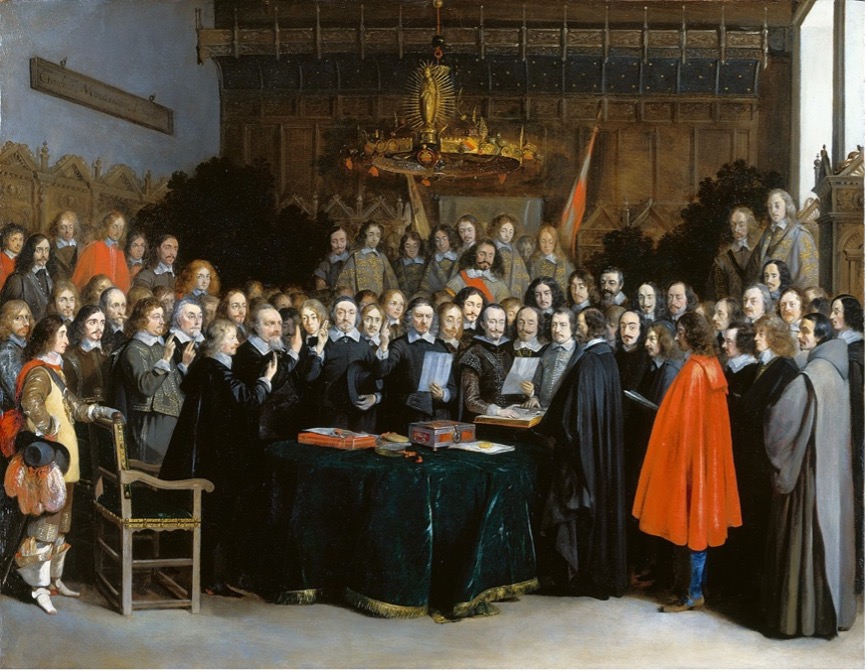
Source: Gerard ter Borch (II)
Public Domain
For 30 years, a war raged in Europe over religious and political tensions between Protestant and Catholic states in the Holy Roman Empire. An estimated 8 million people died from battle, famine, and disease. But, in 1648, the Peace of Westphalia was signed to end the Thirty Years’ War. That treaty was an offshoot of a series of treaties that worked hard to accept state sovereignty and the right to govern themselves and permitted them to enter alliances with other independent states, kingdoms, duchies, and free cities. The Peace of Augsburg, an earlier treaty, allowed citizens to choose between religions by recognizing and accommodating two faiths. It took enormous negotiating skills to procure a deal, but it happened through clever diplomacy. That brutal war changed the map of Europe.

Public Domain
Many books and war analysts tell how wars begin and end. We know how they start; ending one is far more complicated. Even after the end of World War II, with all the evidence of a defeated Germany and an unconditional surrender on May 8, 1945, the Allies took two years to negotiate a lasting peace treaty. For six years, the peace negotiations focused on Poland, a victor of the war, but not strong enough to counter Russia’s insistence, because a large portion of Polish territory belonged to the Russian Empire before World War I. And even though Japan surrendered on September 2, 1945, the Allied Treaty with Japan was finally signed on September 8, 1951. When settled by the final World War II treaty, it gave hope for an end to all wars.
Few wars end in unconditional surrender. Most end through diplomatic assurances that both sides agree to, such as ceasefires, armistices, and treaties marking the end of hostilities. Wars are not sports competitions where sides play to win for glory and advancement. We should assess every war differently but, in general, the point of war is not about winning. Soldiers, sailors, marines, and airmen at war, from junior rank to general and admiral, fight to win. Heads of state and their advisors, however, should have a different mandate: not to win but to compromise to a balanced level that benefits all sides. Nobody wants deaths, and we should expect that the goals of war are to balance arguments with concessions, perhaps by territory or material given for this or that, or public opinion. The notion of victory is not in the winning of wars, but rather the settlement that brings peace and prosperity to both sides. Otherwise, we will always be at war with one another; of the 195 countries that share the resources of this one planet, some will be winners that eventually become losers, and losers that later become winners in a cycle of power changes that continues until the sun becomes a white dwarf.
About the Author
 Joseph Mazur is an Emeritus Professor of Mathematics at Emerson College’s Marlboro Institute for Liberal Arts & Interdisciplinary Studies. He is a recipient of fellowships from the Guggenheim, Bogliasco, and Rockefeller Foundations, and the author of eight acclaimed popular nonfiction books. His latest book is The Clock Mirage: Our Myth of Measured Time (Yale).
Notes
[1] https://www.foreignaffairs.com/united-states/what-happened-west?s=EDZZZ005ZX&utm_medium=newsletters&utm_source=fatoday&utm_campaign=What%20Happened%20to%20%E2%80%9Cthe%20West%E2%80%9D?&utm_content=20250918&utm_term=EDZZZ005ZX
[2] https://www.foreignaffairs.com/united-states/new-economic-geography-posen?utm_medium=promo_email&utm_source=edit&utm_campaign=post_release_posen_actives&utm_content=20250828&utm_term=all-actives
[3] https://www.foreignaffairs.com/united-states/vision-trump-war?utm_medium=newsletters&utm_source=fabackstory&utm_content=20251026&utm_campaign=NEWS_Backstory_102625_A%20Vision%20of%20Trump%20at%20War&utm_term=Backstory_Newsletter#
[4] https://www.csis.org/analysis/us-foreign-assistance-age-strategic-competition#:~:text=The%20Ugly%20American%2C%20a%201958,interms%20of%20foreign%20aid%20disbursements.
[5] https://www.nytimes.com/2021/04/05/world/europe/iran-nuclear-talks-explained.html#:~:text=Defense%20Secretary%20Lloyd%20J.,to%20further%20complicate%20the%20talks.
[6] https://www.nytimes.com/2025/10/27/opinion/israel-hamas-gaza-peace.html
[7] https://www.nytimes.com/2025/10/09/opinion/trump-israel-nobel-gaza.html?nl=Opinion+Today
[8] https://www.nytimes.com/2025/10/09/opinion/putin-poland-radoslaw-sikorski.html?nl=Opinion+Today
[9] https://www.themoscowtimes.com/2025/09/29/putin-orders-highest-fall-conscription-target-in-9-years-a90658
[10] https://www.foreignaffairs.com/russia/wrong-way-do-diplomacy-russia
[11] Ibid. Foreign Affairs.
[12] https://en.zona.media/article/2025/10/10/casualties_eng-trl
[13] https://www.foreignaffairs.com/ukraine/real-limits-ukrainian-power