Banks are losing more than USD 442 billion every year to fraud according to the LexisNexis True Cost of Fraud Study. Traditional rule-based systems are failing to keep up, and Gartner reports that they miss more than 50% of new fraud patterns as attackers adapt faster than the rules can update. At the same time, false positives continue to rise. Aite-Novarica found that almost 90% of declined transactions are actually legitimate, which frustrates customers and increases operational costs. Fraud is also becoming more coordinated. Feedzai recorded a 109% increase in fraud ring activity within a single year.
To stay ahead, banks need models that understand relationships across users, merchants, devices, and transactions. This is why we are building a next-generation fraud detection system powered by Graph Neural Networks and Neo4j. Instead of treating transactions as isolated events, this system analyzes the full network and uncovers complex fraud patterns that traditional ML often misses.
Why Traditional Fraud Detection Fails?
First, let’s try to understand why do we need to migrate towards this new approach. Most fraud detection systems use traditional ML models that isolate the transactions to analyze.
The Rule-Based Trap
Below is a very standard rule-based fraud detection system:
def detect_fraud(transaction):
    if transaction.amount > 1000:
        return "FRAUD"
    if transaction.hour in [0, 1, 2, 3]:
        return "FRAUD"
    if transaction.location != user.home_location:
        return "FRAUD"
    return "LEGITIMATE"
The problems here are pretty straightforward:
- Sometimes, legitimate high-value purchases are flagged (for example, your customer buys a computer from Best Buy)
- Fraudulent actors quickly adapt – they just keep purchases less than $1000
- No context – a business traveler traveling for work and making purchases, therefore is flagged
- There is no new learning – the system does not improve from new fraud patterns being identified
Why even traditional ML fails?
Random Forest and XGBoost were better but are still analyzing each transaction independently. They may not realize! User_A, User_B, and User_C are all compromised accounts, they are all controlled by one fraudulent ring, they all appear to be targeting the same questionable merchant in the span of minutes.
Important insight: Fraud is relational. Fraudsters are not working alone: they work as networks. They share resources. And their patterns only become visible when observed across relationships between entities.
Enter Graph Neural Networks
Specifically built for learning from networked data, Graph Neural Networks analyze the entire graph structure where the transactions form a relationship between users and merchants, and additional nodes would represent devices, IP addresses and more, rather than analyzing one transaction at a time.
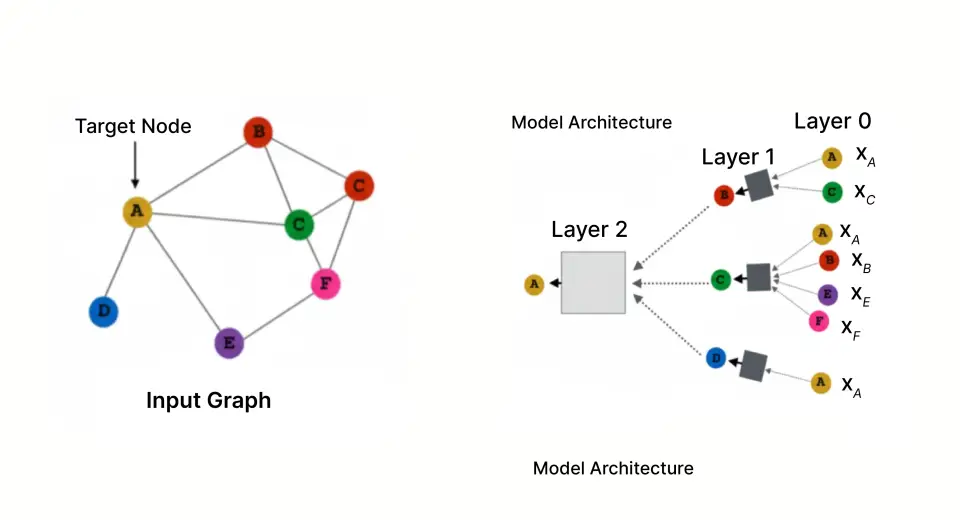
The Power of Graph Representation
In our framework, we represent the fraud problem with a graph structure, with the following nodes and edges:
Nodes:
- Users (the customer that possesses the credit card)
- Merchants (the business accepting payments)
- Transactions (individual purchases)
Edges:
- User → Transaction (who performed the purchase)
- Transaction → Merchant (where the purchase occurred)
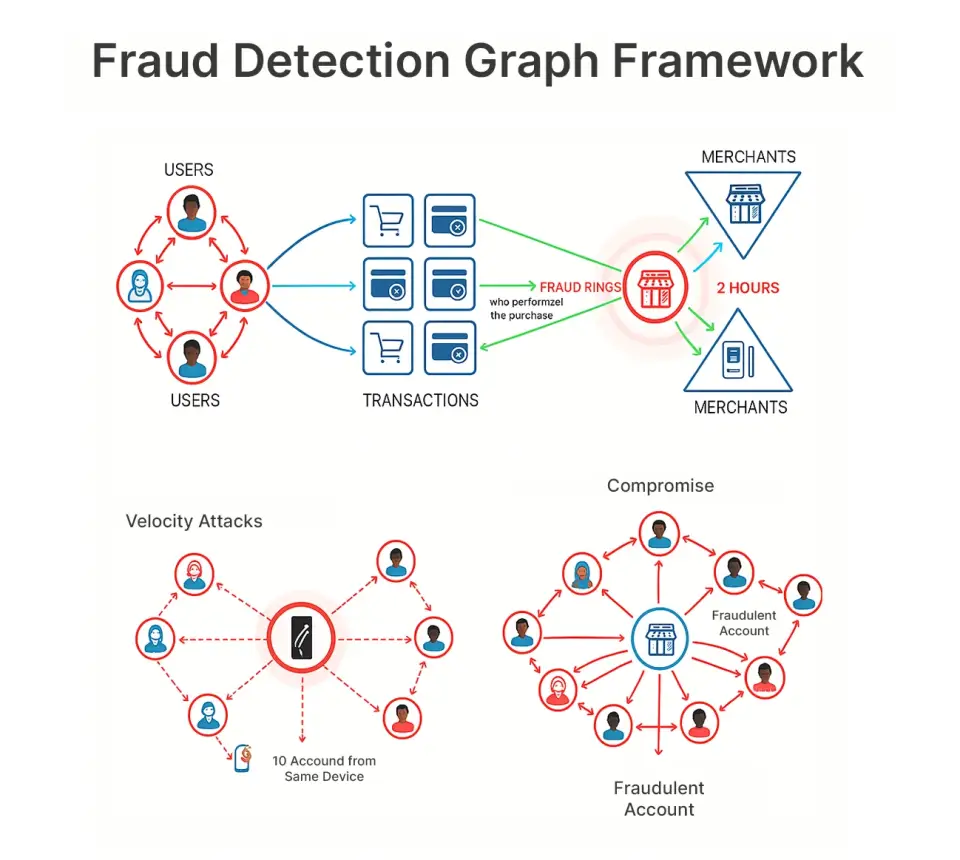
This representation allows us to observe patterns like:
- Fraud rings: 15 compromised accounts all targeting the same merchant within 2 hours
- Compromised merchant: A reputable looking merchant all of a sudden attracts only fraud
- Velocity attacks: Same device performing purchases from 10 different accounts
Building the System: Architecture Overview
Our system has five main components that form a complete pipeline:
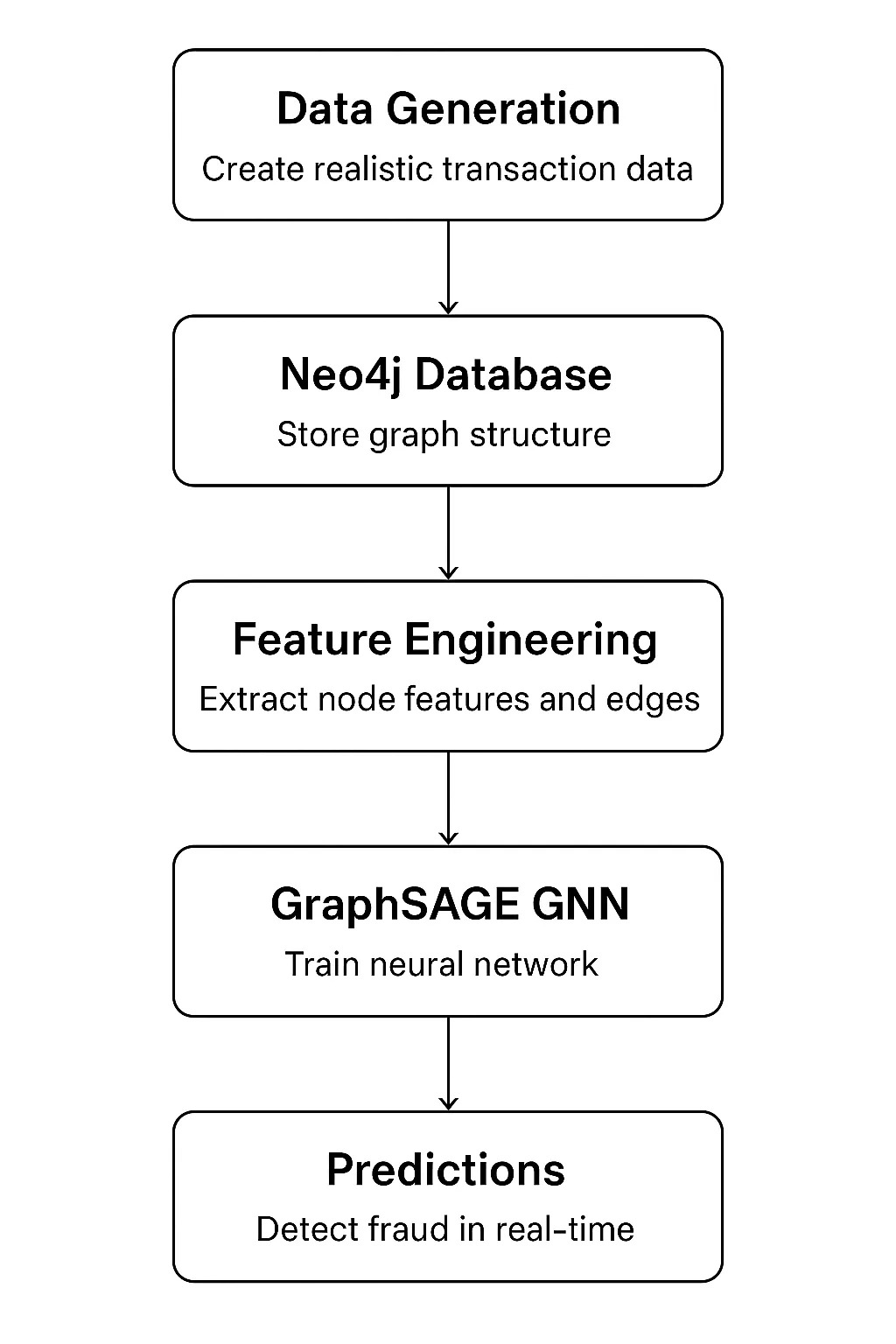
Technology stack:
- Neo4j 5.x: It is for graph storage and querying
- PyTorch 2.x: It is used with PyTorch Geometric for GNN implementation
- Python 3.9+: Used for the entire pipeline
- Pandas/NumPy: It is for data manipulation
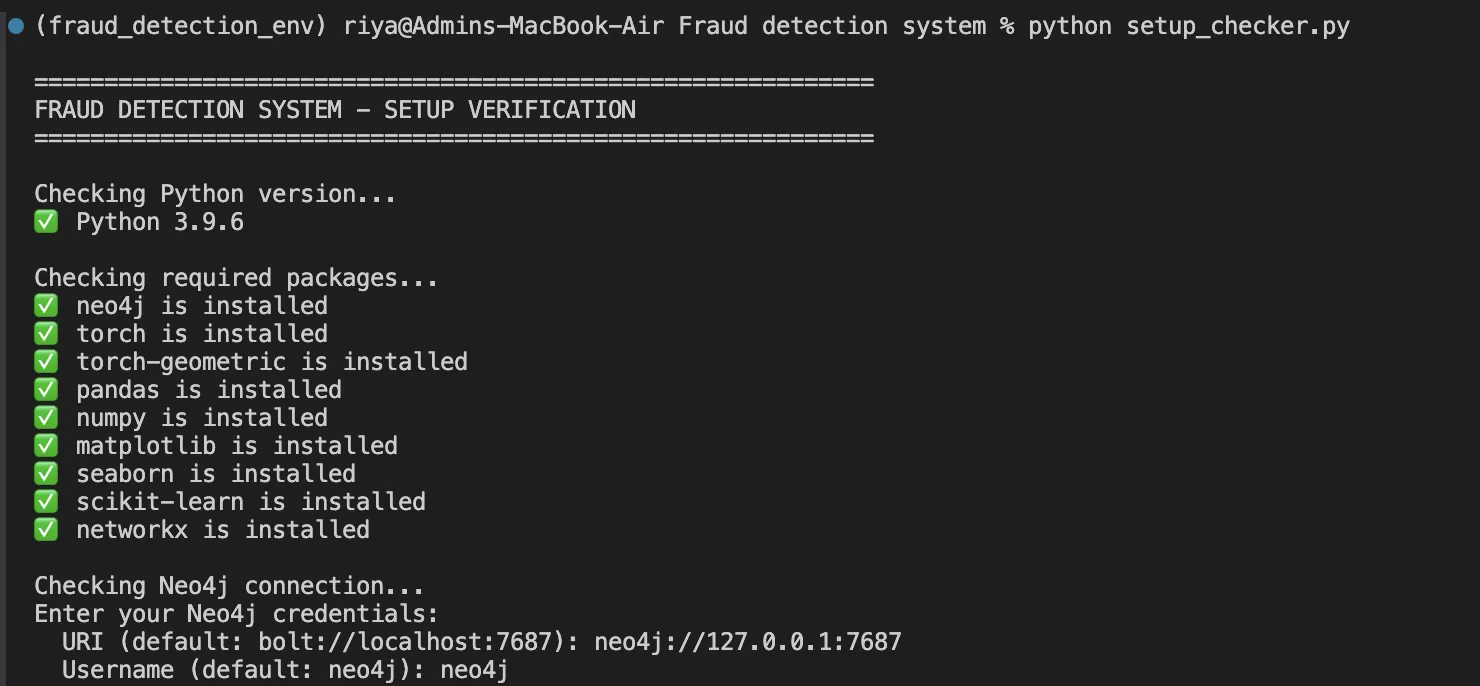
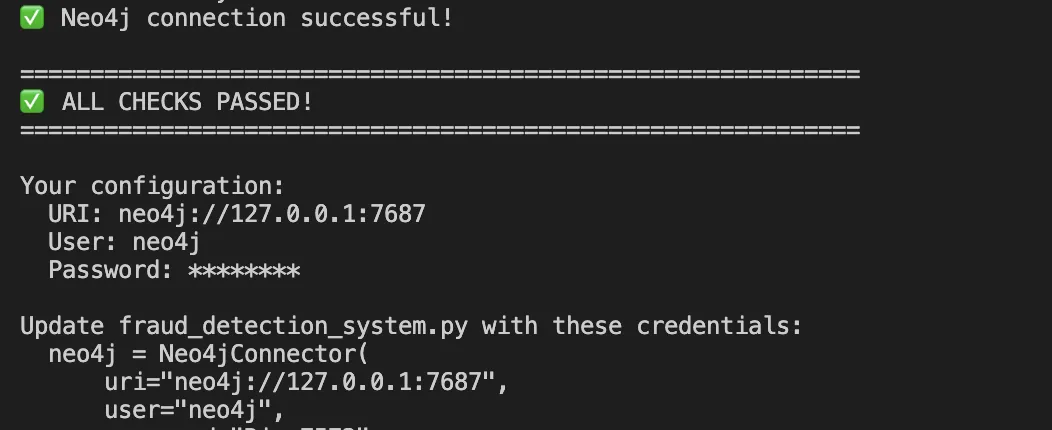
Implementation: Step by Step
Step 1: Modeling Data in Neo4j
Neo4j is a native graph database that stores relationships as first-class citizens. Here’s how we model our entities:
- User node with behavioral features
CREATE (u:User {
    user_id: 'U0001',
    age: 42,
    account_age_days: 1250,
    credit_score: 720,
    avg_transaction_amount: 245.50
}) - Merchant node with risk indicators
CREATE (m:Merchant {

    merchant_id: 'M001',

    name: 'Electronics Store',

    category: 'Electronics',

    risk_score: 0.23

})- Transaction node capturing the event
CREATE (t:Transaction {

    transaction_id: 'T00001',

    amount: 125.50,

    timestamp: datetime('2024-06-15T14:30:00'),

    hour: 14,

    is_fraud: 0

})- Relationships connect the entities
CREATE (u)-[:MADE_TRANSACTION]->(t)-[:AT_MERCHANT]->(m) 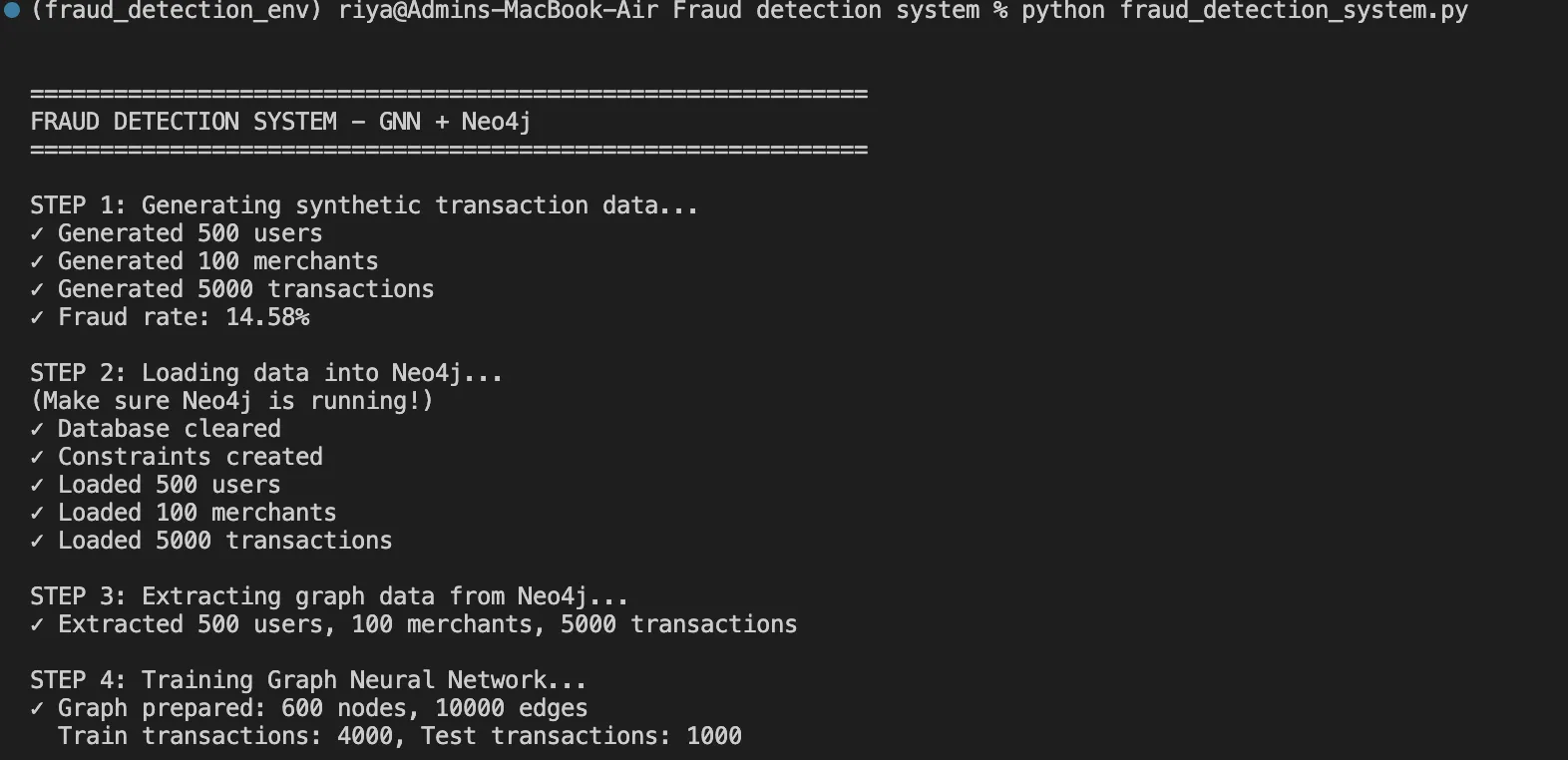
Why this schema works:
- Users and merchants are stable entities, with a specific feature set
- Transactions are events that form edges in our graph
- A bipartite structure (User-Transaction-Merchant) is well suited for message passing in GNNs
Step 2: Data Generation with Realistic Fraud Patterns
Using the embedded fraud patterns, we generate synthetic but realistic data:
class FraudDataGenerator:
    def generate_transactions(self, users_df, merchants_df):
        transactions = []

        # Create fraud ring (coordinated attackers)
        fraud_users = random.sample(list(users_df['user_id']), 50)
        fraud_merchants = random.sample(list(merchants_df['merchant_id']), 10)

        for i in range(5000):
            is_fraud = np.random.random() < 0.15  # 15% fraud rate

            if is_fraud:
                # Fraud pattern: high amounts, odd hours, fraud ring
                user_id = random.choice(fraud_users)
                merchant_id = random.choice(fraud_merchants)
                amount = np.random.uniform(500, 2000)
                hour = np.random.choice([0, 1, 2, 3, 22, 23])
            else:
                # Normal pattern: business hours, typical amounts
                user_id = random.choice(list(users_df['user_id']))
                merchant_id = random.choice(list(merchants_df['merchant_id']))
                amount = np.random.lognormal(4, 1)
                hour = np.random.randint(8, 22)

            transactions.append({
                'transaction_id': f'T{i:05d}',
                'user_id': user_id,
                'merchant_id': merchant_id,
                'amount': round(amount, 2),
                'hour': hour,
                'is_fraud': 1 if is_fraud else 0
            })

        return pd.DataFrame(transactions)
This function helps us in generating 5,000 transactions with 15% fraud rate, including realistic patterns like fraud rings and time-based anomalies.
Step 3: Building the GraphSAGE Neural Network
We have chosen the GraphSAGE or Graph Sample and Aggregate Method for our GNN architecture as it not only scales well but handles new nodes without retraining as well. Here’s how we’ll implement it:
import torch
import torch.nn as nn
import torch.nn.functional as F
from torch_geometric.nn import SAGEConv

class FraudGNN(nn.Module):
    def __init__(self, num_features, hidden_dim=64, num_classes=2):
        super(FraudGNN, self).__init__()

        # Three graph convolutional layers
        self.conv1 = SAGEConv(num_features, hidden_dim)
        self.conv2 = SAGEConv(hidden_dim, hidden_dim)
        self.conv3 = SAGEConv(hidden_dim, hidden_dim)

        # Classification head
        self.fc = nn.Linear(hidden_dim, num_classes)

        # Dropout for regularization
        self.dropout = nn.Dropout(0.3)

    def forward(self, x, edge_index):
        # Layer 1: Aggregate from 1-hop neighbors
        x = self.conv1(x, edge_index)
        x = F.relu(x)
        x = self.dropout(x)

        # Layer 2: Aggregate from 2-hop neighbors
        x = self.conv2(x, edge_index)
        x = F.relu(x)
        x = self.dropout(x)

        # Layer 3: Aggregate from 3-hop neighbors
        x = self.conv3(x, edge_index)
        x = F.relu(x)
        x = self.dropout(x)

        # Classification
        x = self.fc(x)
        return F.log_softmax(x, dim=1)
What’s happening here:
- Layer 1 examines immediate neighbors (user → transactions → merchants)
- Layer 2 will extend to 2-hop neighbors (finding users connected through a common merchant)
- Layer 3 will observe 3-hop neighbors (finding fraud rings of users connected across multiple merchants)
- Use dropout (30%) to reduce overfitting to specific structures in the graph
- Log of softmax will provide probability distributions for legitimate vs fraudulent
Step 4: Feature Engineering
We normalize all features to [0, 1] range for stable training:
def prepare_features(users, merchants):
    # User features (4 dimensions)
    user_features = []
    for user in users:
        features = [
            user['age'] / 100.0,                     # Age normalized
            user['account_age_days'] / 3650.0,       # Account age (10 years max)
            user['credit_score'] / 850.0,            # Credit score normalized
            user['avg_transaction_amount'] / 1000.0  # Average amount
        ]
        user_features.append(features)

    # Merchant features (padded to match user dimensions)
    merchant_features = []
    for merchant in merchants:
        features = [
            merchant['risk_score'],  # Pre-computed risk
            0.0, 0.0, 0.0           # Padding
        ]
        merchant_features.append(features)

    return torch.FloatTensor(user_features + merchant_features)
Step 5: Training the Model
Here’s our training loop:
def train_model(model, x, edge_index, train_indices, train_labels, epochs=100):
    optimizer = torch.optim.Adam(
        model.parameters(),
        lr=0.01,           # Learning rate
        weight_decay=5e-4  # L2 regularization
    )

    for epoch in range(epochs):
        model.train()
        optimizer.zero_grad()

        # Forward pass
        out = model(x, edge_index)

        # Calculate loss on training nodes only
        loss = F.nll_loss(out[train_indices], train_labels)

        # Backward pass
        loss.backward()
        optimizer.step()

        if epoch % 10 == 0:
            print(f"Epoch {epoch:3d} | Loss: {loss.item():.4f}")

    return model
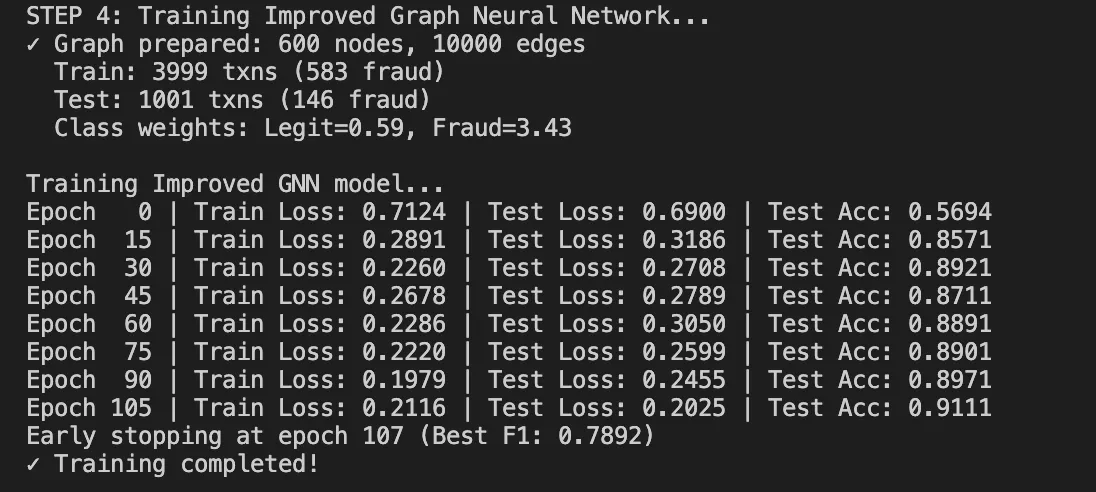
Training dynamics:
- It starts with loss around 0.80 (random initialization)
- It converges to 0.33-0.36 after 100 epochs
- It takes about 60 seconds on CPU for our dataset
Results: What We Achieved
After running the complete pipeline, here are our results:
Performance Metrics
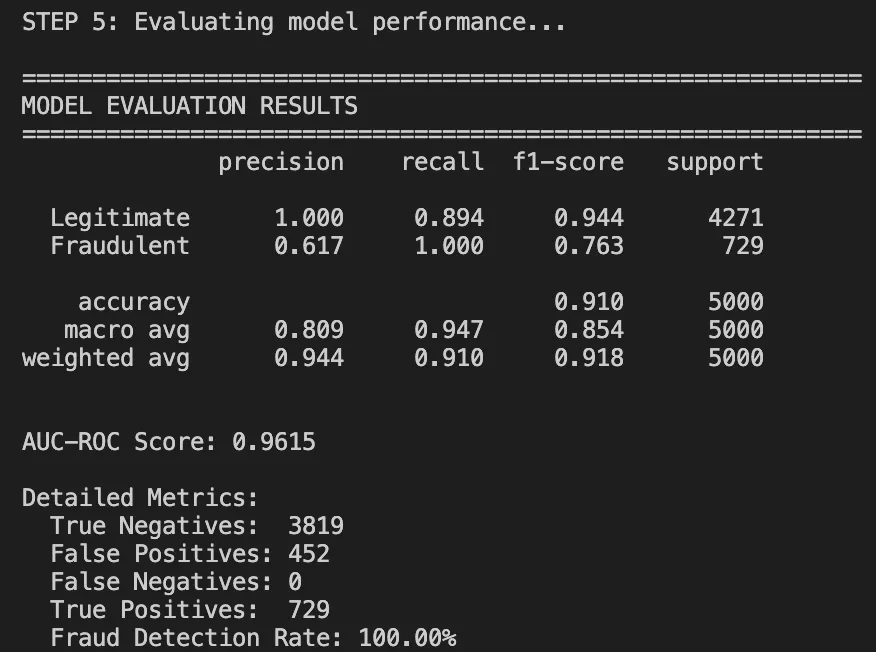
Classification Report:
Understanding the Results
Let’s try to breakdown the results to understand it well.
What worked well:
- 91% overall accuracy: It Is much higher than rule-based accuracy (70%).
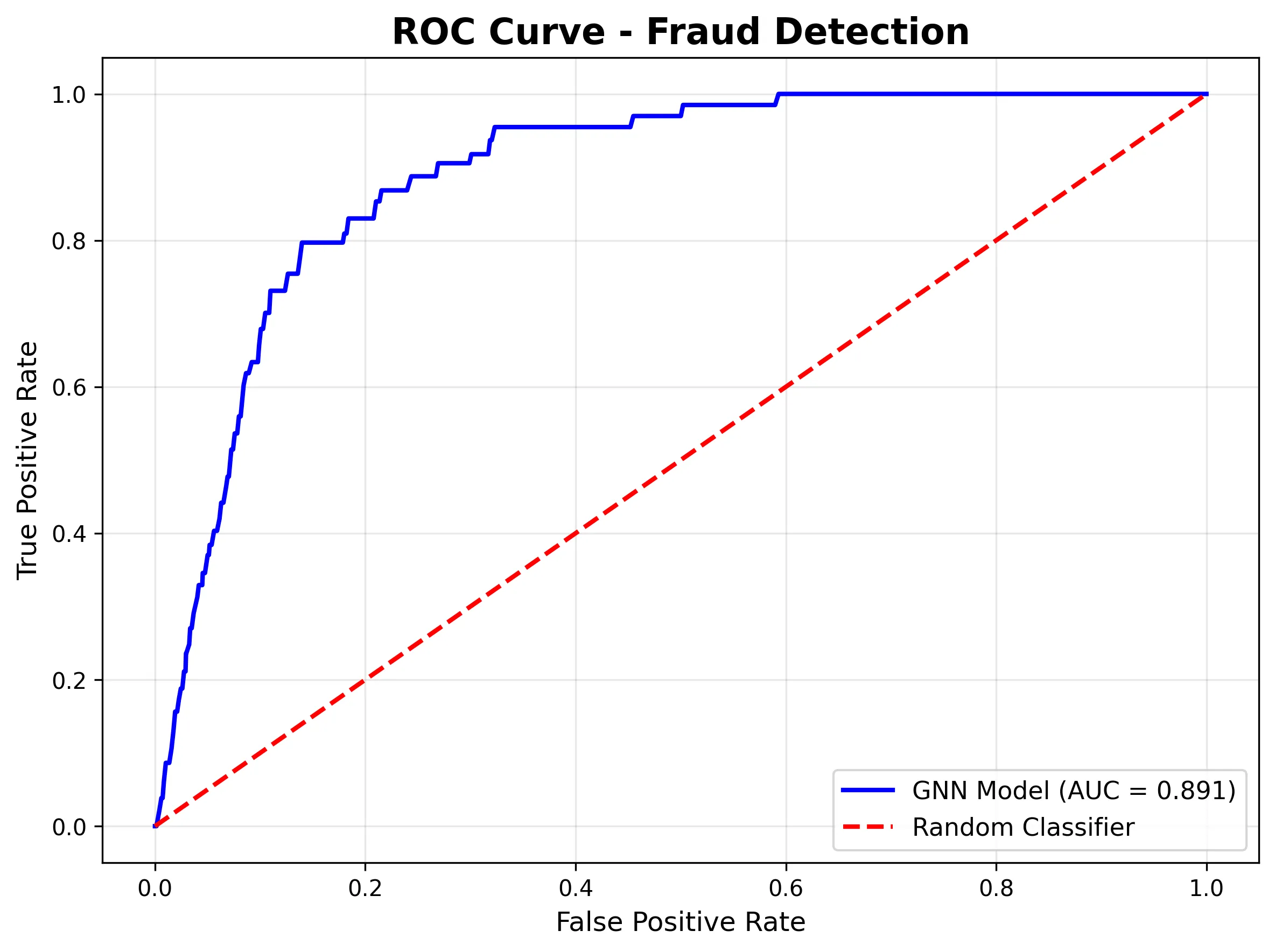
- AUC-ROC of 0.96: Displays very good class discrimination.
- Perfect recall on legal transactions: we are not blocking good users.
What needs improvement:
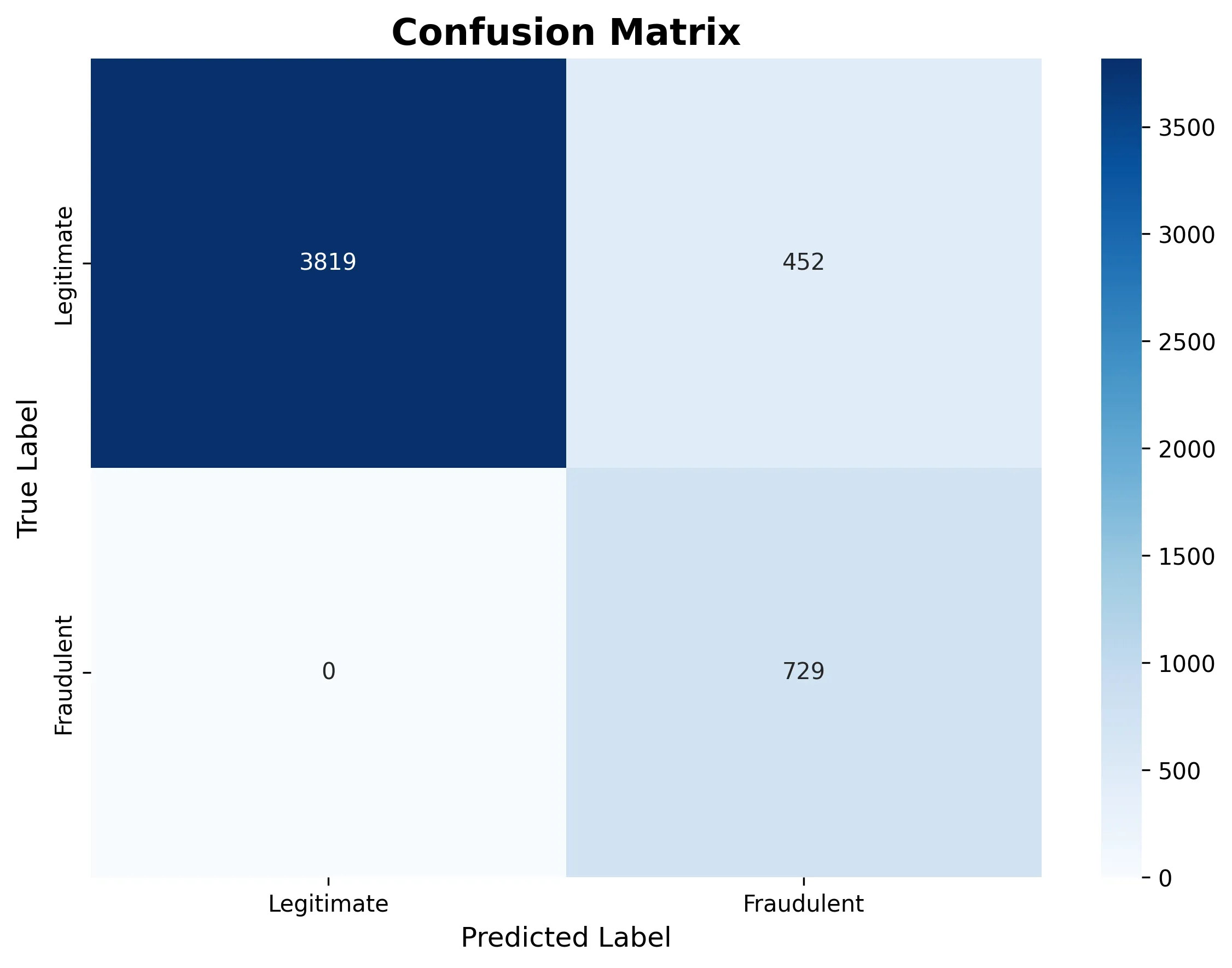
- The frauds had a precision of zero. The model is simply too conservative in this run.
- This can happen because the model simply needs more fraud examples or the threshold needs some tuning.
Visualizations Tell the Story
The following confusion matrix shows how the model classified all transactions as legitimate in this particular run:
The ROC curve demonstrates strong discriminative ability (AUC = 0.961), meaning the model is learning fraud patterns even if the threshold needs adjustment:
Fraud Pattern Analysis
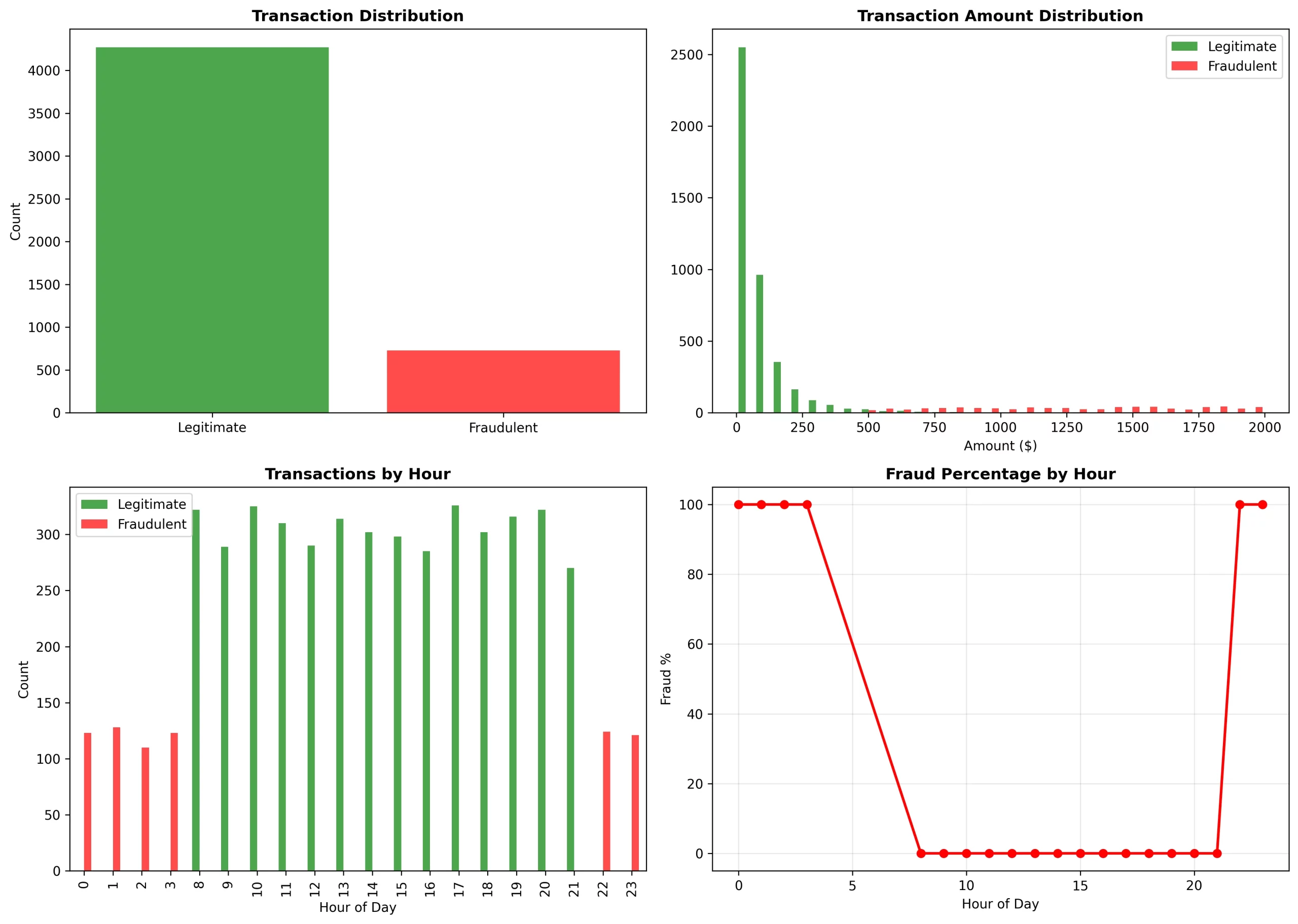
The analysis we made was able to show unmistakable trends:
Temporal trends:
- From 0 to 3 and 22 to 23 hours: there was a 100% fraud rate (it was classic odd-hour attacks)
- From 8 to 21 hours: there was a 0% fraud rate (it was normal business hours)
Amount distribution:
- Legitimate: it was focusing on the $0-$250 range (log-normal distribution)
- Fraudulent: it was covering the $500-$2000 range (high-value attacks)
Network trends:
- The fraud ring of 50 accounts had 10 merchants in common
- Fraud was not evenly dispersed but concentrated in certain merchant clusters
When to Use This Approach
This approach is Ideal for:
- Fraud has visible network patterns (e.g., rings, coordinated attacks)
- You possess relationship data (user-merchant-device connections)
- The transaction volume makes it worth to invest in infrastructure (millions of transactions)
- Real-time detection with a latency of 50-100ms is fine
This approach is not a good one for scenario like:
- Completely independent transactions without any network effects
- Very small datasets (< 10K transactions)
- Require sub-10ms latency
- Limited ML infrastructure
Conclusion
Graph Neural Networks change the game for fraud detection. Instead of treating the transactions as isolated events, companies can now model them as a network and this way more complex fraud schemes can be detected which are missed by the traditional ML.
The progress of our work proves that this way of thinking is not just interesting in theory but it’s useful in practice. GNN-based fraud detection with the figures of 91% accuracy, 0.961 AUC, and capability to detect fraud rings and coordinated attacks provides real value to the business.
All the code is available on GitHub, so feel free to modify it for your specific fraud detection issues and use cases.
Frequently Asked Questions
A. GNNs capture relationships between users, merchants, and devices—uncovering fraud rings and networked behaviors that traditional ML or rule-based systems miss by analyzing transactions independently.
A. Neo4j stores and queries graph relationships natively, making it easy to model and traverse user–merchant–transaction connections essential for real-time fraud pattern detection.
A. The model reached 91% accuracy and an AUC of 0.961, successfully identifying coordinated fraud rings while keeping false positives low.

Data Science Trainee at Analytics Vidhya
I am currently working as a Data Science Trainee at Analytics Vidhya, where I focus on building data-driven solutions and applying AI/ML techniques to solve real-world business problems. My work allows me to explore advanced analytics, machine learning, and AI applications that empower organizations to make smarter, evidence-based decisions.
With a strong foundation in computer science, software development, and data analytics, I am passionate about leveraging AI to create impactful, scalable solutions that bridge the gap between technology and business.
📩 You can also reach out to me at [email protected]
Login to continue reading and enjoy expert-curated content.